

Table of Contents
Why This Matters Now
Why AI Recommendations Work Differently to Google Rankings
What We Tested: Asking ChatGPT to Choose a Solar Installer
What AI Systems Actually Look For
The Practical Playbook
The Compounding Effect
This Is Exactly What We Do at Orvanti
Why This Matters Now
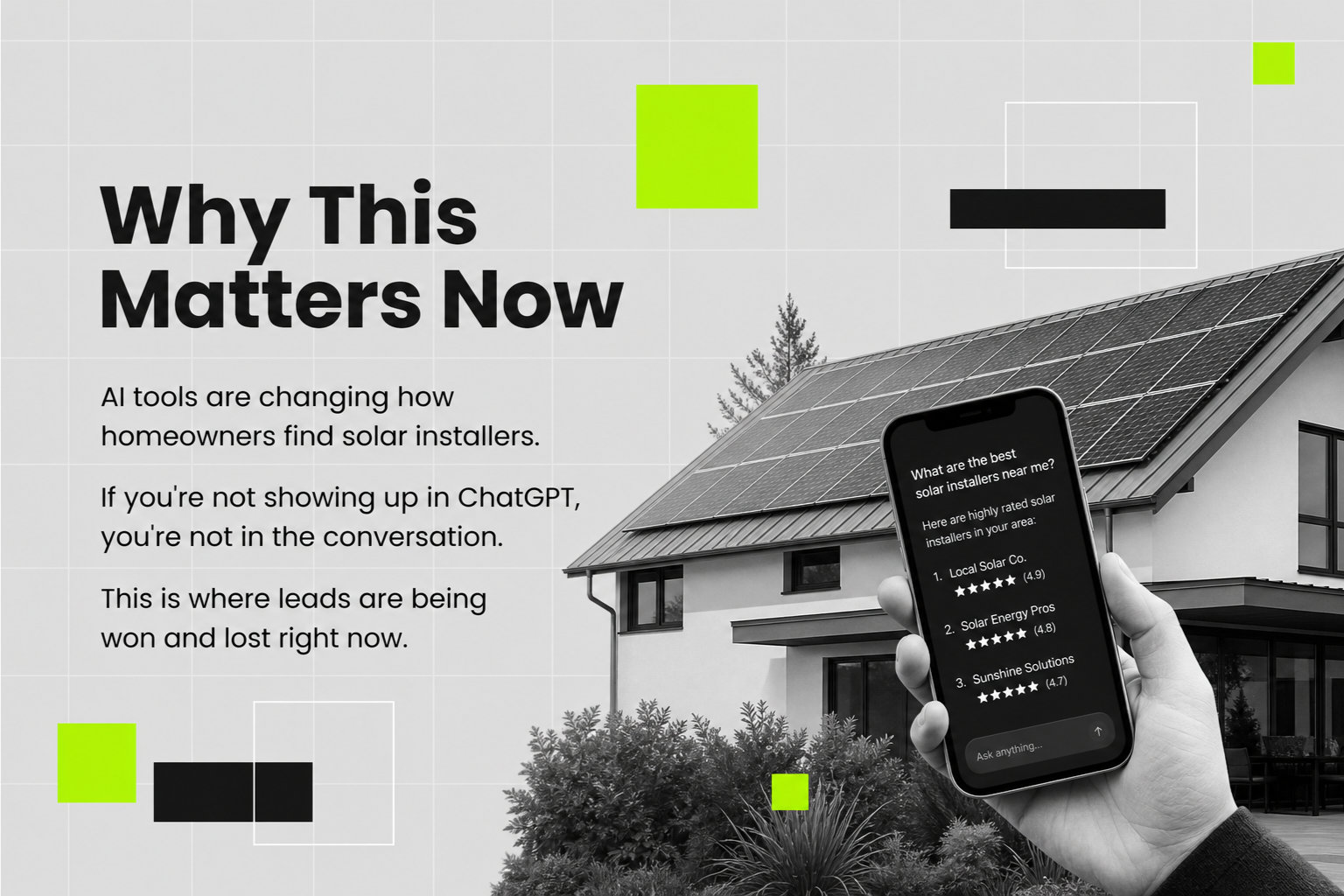
Something has quietly shifted in how homeowners find solar installers.
They're still using Google. But increasingly, they're also asking ChatGPT, using AI Overviews at the top of search results, or speaking to voice assistants before they ever click anything. And the businesses showing up in those AI-generated answers aren't necessarily the ones with the best Google Ads or the highest SEO rankings. They're the ones that look most credible to a machine.
This matters for solar installers specifically because solar is a considered purchase. Homeowners spend weeks researching before they contact anyone. If an AI recommends your competitors three times during that research window and doesn't mention you once, you've already lost the lead before it was ever a lead.
This guide explains exactly how AI systems decide who to recommend, and what you need to do to be the obvious choice.
Key points:
Homeowners are increasingly using AI tools to research before contacting any installer
AI recommendations are driven by credibility signals, not just ad spend or rankings
Losing the AI visibility game means losing leads before they even reach your website
Why AI Recommendations Work Differently to Google Rankings
SEO is about optimising signals for Google's algorithm. AI recommendations are about something broader: does your business look real, trusted, and consistently talked about everywhere a homeowner might look?
When an AI system is asked "who are the best solar installers in Somerset," it isn't just reading your website. It's cross-referencing everything it can find: your reviews, your presence on trusted directories, what your past customers said, how consistently your business name and details appear across the web.
Think of it less like an algorithm and more like a well-researched recommendation from someone who checked multiple sources before giving you an answer. The businesses that get recommended consistently are the ones that have made it easy for an AI to justify choosing them. That's the frame everything in this guide sits within.
Key points:
SEO and AI visibility are related but not the same thing
AI systems cross-reference multiple sources before recommending a business
The goal is to make your business the easiest choice for an AI to justify
What We Tested: Asking ChatGPT to Choose a Solar Installer
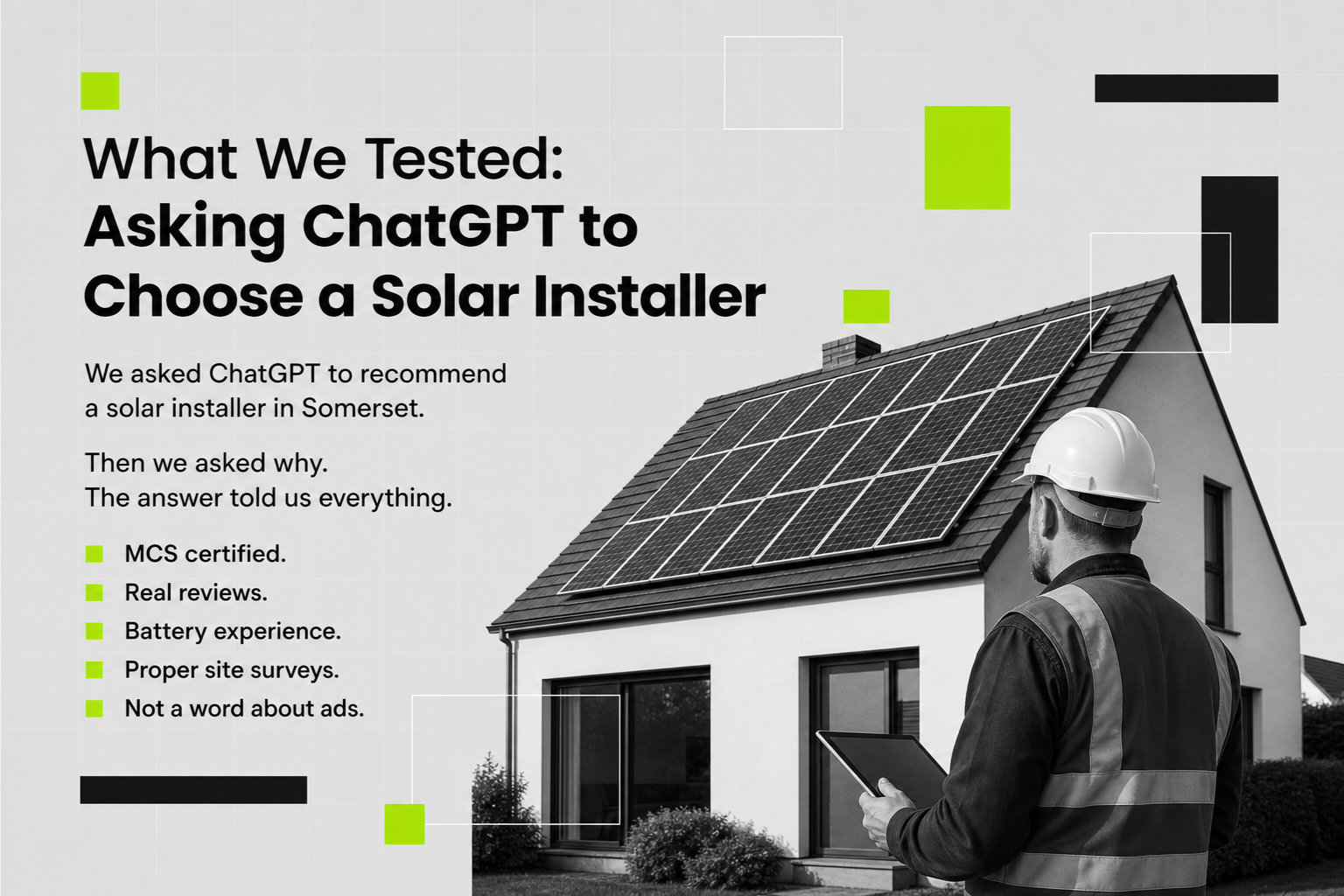
We didn't just theorise about this. We tested it directly, asking ChatGPT to recommend solar installers in Somerset and then asking it to explain its reasoning. The results were instructive.
When asked what actually makes one installer "the best" in Somerset specifically, ChatGPT said:
"In Somerset specifically, you want to prioritise MCS certification (required for government export payments), strong recent reviews (not just ratings), experience with battery systems (huge ROI boost), and a company that does a proper site survey rather than generic quotes."
That's not a list we wrote. That's what the AI surfaced when pushed to explain its selection criteria. And it maps almost exactly to the signals we cover in this guide.
What's worth noting is what didn't come up: Google Ads performance, website design, how polished the branding is. The factors ChatGPT weighted were all about verifiable trust signals and evidence of real-world capability. The installers it recommended were the ones that had built a visible, coherent record of doing good work for real customers in that specific area.
If your business can't be justified by those criteria, no amount of ad spend changes the outcome.
Key points:
We tested this directly with ChatGPT using real Somerset installer searches
ChatGPT prioritised MCS certification, genuine reviews, battery expertise, and proper site surveys
AI systems weight verifiable trust signals, not marketing polish
Installers that showed up had a clear, coherent record of real local work
What AI Systems Actually Look For
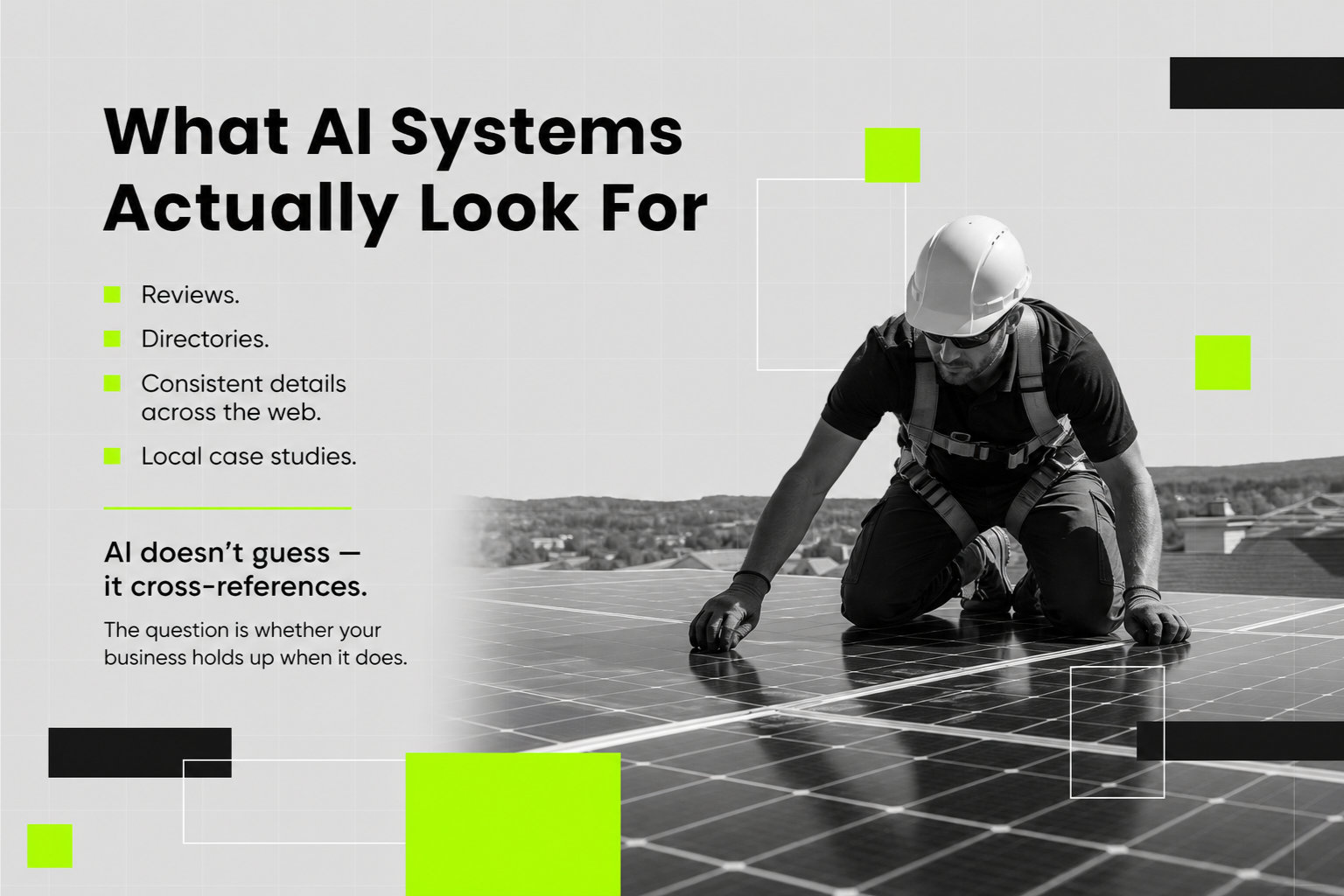
Review Quality and Volume
Not just five stars. Consistent five stars across a meaningful number of reviews, over time. A business with 12 reviews at 4.8 looks very different to one with 90 reviews at 4.9. Volume signals real installations. Recency signals an active business. And the content of reviews, what customers actually say, is one of the most powerful inputs an AI has to work with.
Key points:
Volume and recency matter as much as the star rating itself
Review content (the words customers use) is a direct input to AI recommendations
Aim for consistent growth over time, not a one-time push
Consistent Entity Presence
AI systems build confidence in a business when the same name, address, phone number, and service description appears coherently across multiple trusted sources: your Google Business Profile, Trustpilot, Checkatrade, your own website. Inconsistencies create ambiguity. Ambiguity reduces the likelihood of recommendation.
Key points:
Your business details must be identical across every platform
Inconsistencies in name, address, or phone number undermine AI confidence
Fixing this is step zero before anything else in this guide
Service Completeness
Businesses that mention solar panels, battery storage, EV chargers, and full system installs in the same breath signal broader capability. That broader capability reads as higher authority. A business described only as a "solar panel installer" competes in a narrower pool than one described as a full renewable energy system provider.
Key points:
Listing your full service range increases perceived authority
Battery storage and EV charging are high-value signals in 2026
Narrow descriptions limit the searches you can appear for
Specific Local Relevance
AI systems favour businesses with clear geographic grounding: a physical address, location-specific content, and local mentions. A solar installer in Taunton with case studies from Taunton homeowners, reviews mentioning Taunton, and a GBP tied to a Taunton address will outperform a national brand that doesn't appear rooted anywhere in particular.
Key points:
Geographic specificity consistently outperforms generic national positioning
Case studies and reviews from named local areas are especially valuable
A verified physical address is a meaningful advantage over service-area-only listings
Natural Language Repetition Across Sources
This is subtle but it matters. Phrases like "solar installation in Somerset," "MCS certified installer," and "battery storage system UK" appearing naturally across your website, your reviews, and your directory listings create a consistent language signal. This isn't keyword stuffing. It's the natural repetition that comes from real customers describing real work in similar terms, and it's something you can actively encourage.
Key points:
Consistent terminology across multiple sources strengthens AI retrieval
Encourage customers to use specific language naturally in reviews
MCS certification language is a particularly high-value phrase to have repeated
The Practical Playbook
1. Lock In Your Entity
Before anything else, make sure your business appears identically everywhere. Same business name, same address format, same phone number, same description of what you do. Check your Google Business Profile, your website footer, Checkatrade, Trustpilot, Yell, and any other directory you're listed on.
This creates what's sometimes called a clean knowledge graph footprint. It's the foundation everything else is built on. If this is inconsistent, everything downstream is less effective.
Key points:
Audit every directory and platform your business appears on
Name, address, and phone must match exactly across all sources
Fix inconsistencies before investing time or money in anything else
2. Engineer Your Review Signals
Getting reviews is necessary. Getting the right reviews is the actual goal.
When asking customers for a review, give them a light steer: mention where they are (the town or area), the system they had installed (solar plus battery, for example), and the outcome they experienced (bill reduction, energy independence). Most happy customers are willing to do this if you make it easy. A short WhatsApp message with a direct review link and a sentence of guidance is enough.
The result is reviews that naturally contain the phrases AI systems look for when deciding who to recommend for a specific search in a specific location.
Key points:
Prompt customers with light guidance on what to mention in their review
Location, system type, and outcome are the three most valuable elements to include
A WhatsApp message with a direct link is the most frictionless approach
3. Build Pages That Answer Real Questions
Your website should have dedicated, substantive pages for each service and each area you cover. Not thin pages with two paragraphs, but pages that actually answer the questions a homeowner has when they're considering solar.
"Solar Panel Installation in Somerset" should be a proper page: what the install process looks like, what to expect from your team, real case studies, local proof, total costs, typical system sizes. "How to Choose a Solar Installer" is the kind of decision-layer content that gets cited by AI. If you don't have a page answering that question, a competitor or an aggregator does, and they get the citation instead.
Think of this as answer engine optimisation rather than traditional SEO. You're not just trying to rank. You're trying to be the source an AI quotes.
Key points:
One substantive page per service and per area you cover
Decision-layer content ("how to choose," "is solar worth it") gets cited by AI systems
Thin pages consistently underperform regardless of how competitive the niche is
4. Create Local Proof Content
This is consistently underused.
A page titled "4kW Solar Install in Taunton, 3-Bed Semi, 2025" with photos, the system specification, the customer's energy situation before and after, and a genuine result is extremely valuable. It's specific. It's local. It's verifiable. These pages act as ground truth signals, concrete evidence that your business does real work for real people in the area you serve.
Build one of these for every significant install you complete.
Key points:
Case study pages with real photos, specs, and results are high-value signals
Specificity (location, house type, system size) is what makes them credible to AI
These pages build up as a body of local proof over time
5. Be Present in Trusted Ecosystems
Your business should appear on Trustpilot, Checkatrade, and relevant industry directories, with accurate information and genuine reviews on each. Even a handful of mentions in local news coverage or on local business blogs adds to this.
AI systems cross-reference. A business mentioned positively across multiple trusted external sources generates more confidence than a business with a great website but no external presence.
Key points:
Trustpilot, Checkatrade, and solar-specific directories are the priority
Local press mentions and blog features add meaningful credibility
External mentions compound with your own site content, they don't replace it
6. Add Structured Data to Your Site
This is a technical step but a straightforward one. Adding LocalBusiness schema, Product schema for your solar systems, and Review schema to your website pages helps AI systems understand your business without having to infer it from page content. It reduces ambiguity and makes your data machine-readable.
If you're on Framer, WordPress, or another standard CMS, this can usually be added via a plugin or a simple code snippet. Worth doing once and leaving in place.
Key points:
LocalBusiness, Product, and Review schema are the three most relevant types
This is a one-time setup that pays off consistently
Most CMS platforms make this straightforward to implement
7. Cover the Decision Layer
Most solar installers have pages about their services. Fewer have pages targeting the questions homeowners ask at the point of decision:
"Is solar worth it in the UK in 2026?"
"How much does a solar installation cost in Somerset?"
"Best solar installers in the South West, how to compare them"
These pages don't just help with SEO. They're the pages most likely to be cited when someone asks an AI a question during their research. If you don't have them, the answer comes from someone who does.
Key points:
Decision-layer content is the most cited content in AI responses
Price guides, comparison pages, and "is it worth it" content all qualify
Each page you don't have is a citation opportunity you're handing to a competitor
The Compounding Effect
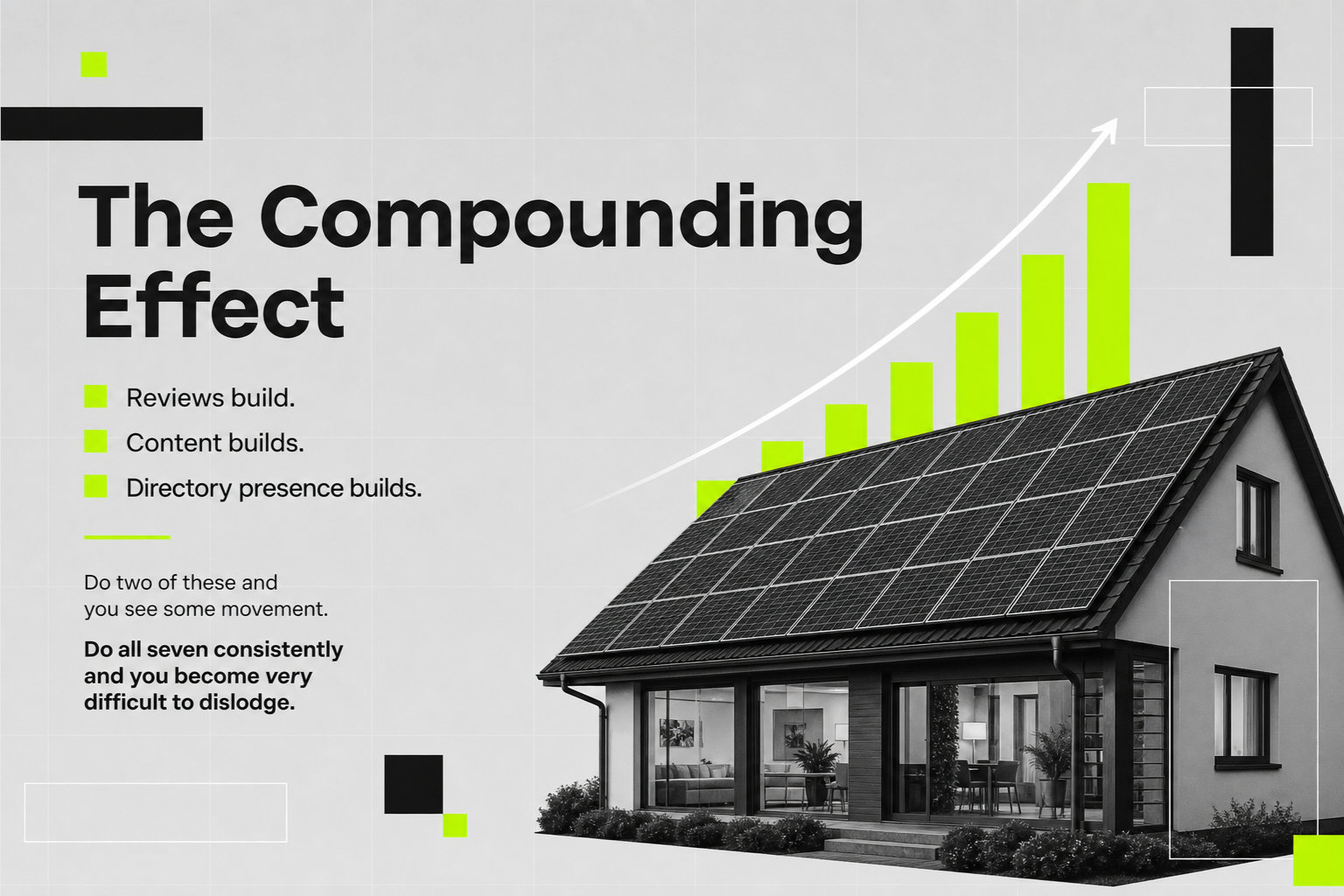
None of this works in isolation. A business with 90 reviews, a coherent entity presence, substantive local content, and active directory listings compounds into something significantly harder to dislodge than a business that has done two or three of these things well.
This is also not a one-time project. The businesses that hold strong positions in AI recommendations are the ones treating this as an ongoing system: adding case studies regularly, keeping review volume growing, updating content to reflect current pricing and conditions.
The practical question is whether you build this system yourself or have it built for you.
Key points:
Every element reinforces the others; partial implementation produces partial results
Consistency over time is what separates businesses that hold top positions from those that slip
This is a system, not a campaign

This Is Exactly What We Do at Orvanti
The playbook above, entity consistency, structured review campaigns, local authority content, directory presence, sits at the core of how we build acquisition systems for solar installers.
If you want to understand where your business currently stands on AI visibility, and what it would take to become the installer that gets recommended consistently in your area, take a look at our solar lead system here.
It covers exactly how we approach this, and what results solar installers can realistically expect.

Why Choose Orvanti?
Expertise You Can Trust
Our team brings years of industry experience to deliver high-quality ads, conversion and prequalification systems
Tailored Approach
We craft customised strategies that align with your unique business needs and financial objectives.
Data-Driven Insights
Our cutting-edge analytics and financial modeling ensure informed decision-making for long-term success.
Proven Results
We have a track record of helping businesses enhance financial efficiency, manage risks, and achieve their goals.