

Table of Contents
Why Google Reviews Are Not Just a Vanity Metric
What Google Just Changed and Why It Matters
The Five Things Getting Reviews Removed Right Now
How to Get Reviews That Actually Stick
The One Thing Most Businesses Get Wrong With Volume
What to Do Next
Why Google Reviews Are So Important For Local Rankings
Before we get into what changed, it is worth being clear on why this matters commercially.
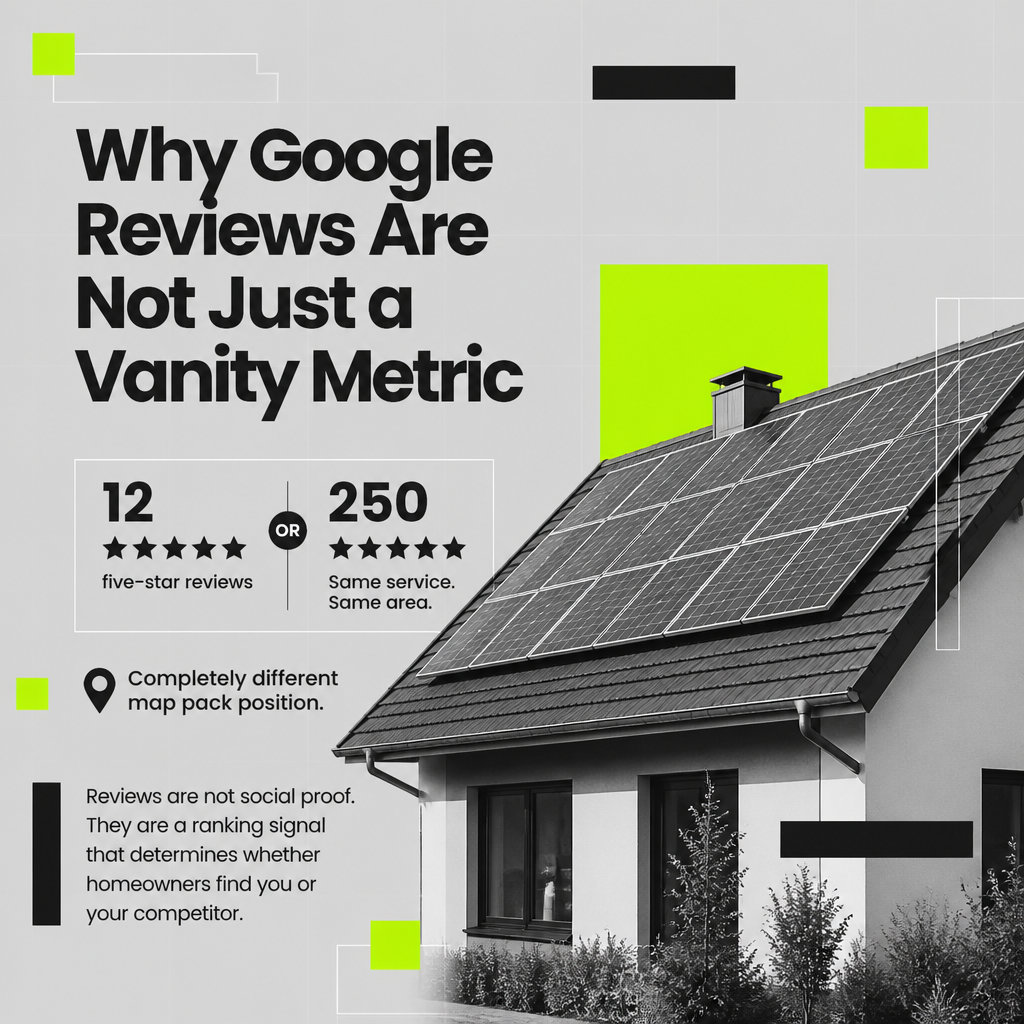
Google reviews are one of the heaviest local ranking signals Google uses. A solar installer with 12 five-star reviews and an installer with 250 five-star reviews are not in the same conversation when it comes to where they appear in local search results. Volume, recency, and the content of reviews all feed directly into how Google ranks your business in the map pack, which sits above organic results and captures a significant share of clicks before anyone scrolls further.
The difference between 12 and 250 reviews is not just optics. It is the difference between appearing on page two for "solar installer Worcester" and being one of the three businesses in the map pack that captures 40% of all local clicks. It affects whether a homeowner calls you or your competitor. It affects your cost per acquisition. It affects your close rate because warm leads who have already seen 200 positive reviews arrive with a different level of trust than those who have seen a dozen.
Reviews compound. A business that generates reviews consistently, from real customers, in a natural pattern, builds a position that is genuinely difficult for a competitor to catch up with quickly. That compounding is now under threat for businesses that have been getting reviews the wrong way, because Google has just made it significantly harder to do that.
Key points:
Review volume and recency are direct local ranking signals, not just social proof
The gap between 12 and 250 reviews has a measurable impact on map pack position and click share
Reviews compound over time: consistent natural growth builds a position that is hard to dislodge
Businesses getting reviews the wrong way are now at risk of losing what they have built
What Google Just Changed and Why It Matters
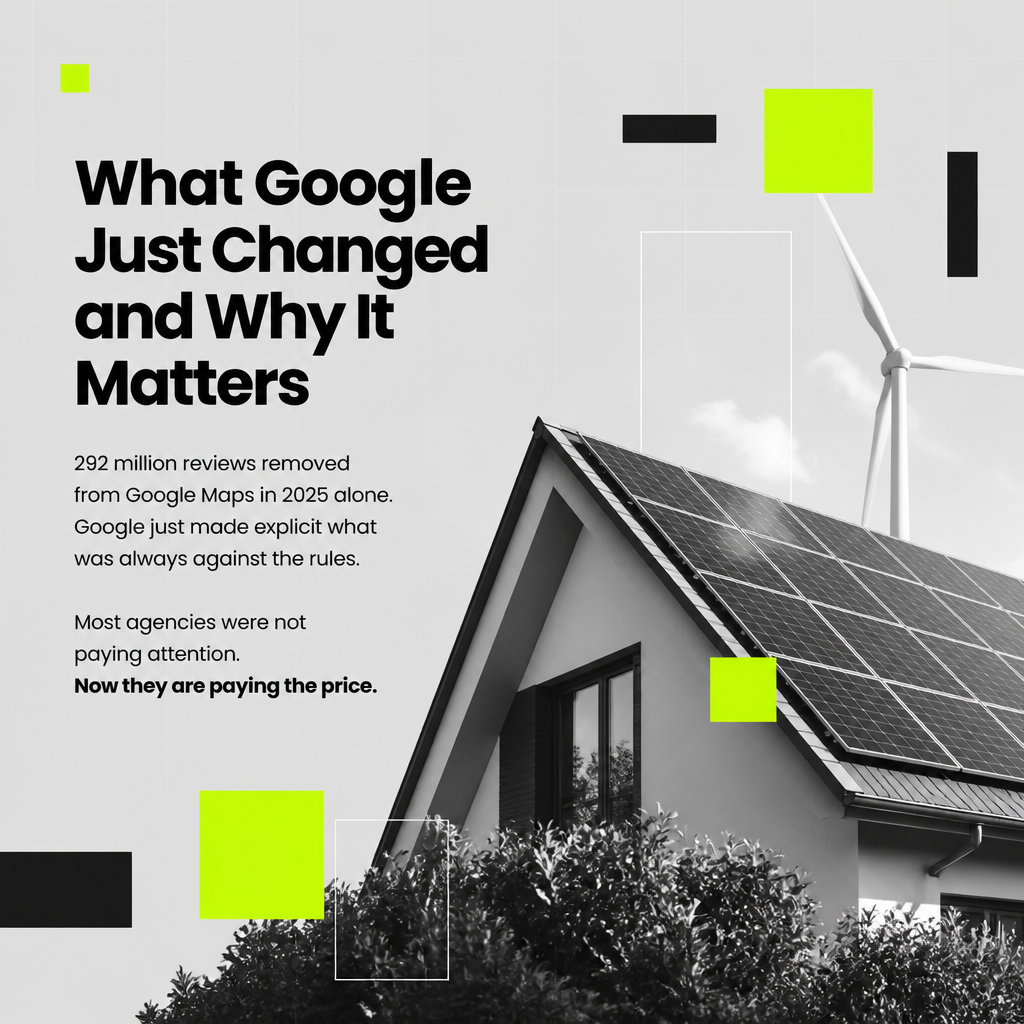
Google recently updated their business profile policies and the prohibited and restricted content section of their guidelines. The update made explicit a number of practices that have been commonplace across marketing agencies and local businesses for years.
In 2025 alone, 292 million reviews were removed from Google Maps. That number is only going up as enforcement tightens.
The core of what changed is this: Google is now explicitly prohibiting businesses and agencies from encouraging customers to include specific content in their reviews. That means no asking for particular keywords or phrases, no asking customers to mention a specific employee, and no incentivising staff to generate a target number of reviews. They have also added a section on rating manipulation that specifically flags unusual volumes or patterns of review contributions as a red flag.
The practical consequence is that millions of businesses and the agencies managing their review processes are now operating outside Google's policies, whether they know it or not.
Key points:
Google has explicitly updated its review policies and is actively enforcing them
292 million reviews were removed from Google Maps in 2025 alone
Unusual spikes in review volume followed by drop-off are now flagged as manipulation
Many standard agency review practices are now directly non-compliant
The Five Things Getting Reviews Removed Right Now
If a client's reviews are disappearing, one or more of these is almost certainly why.
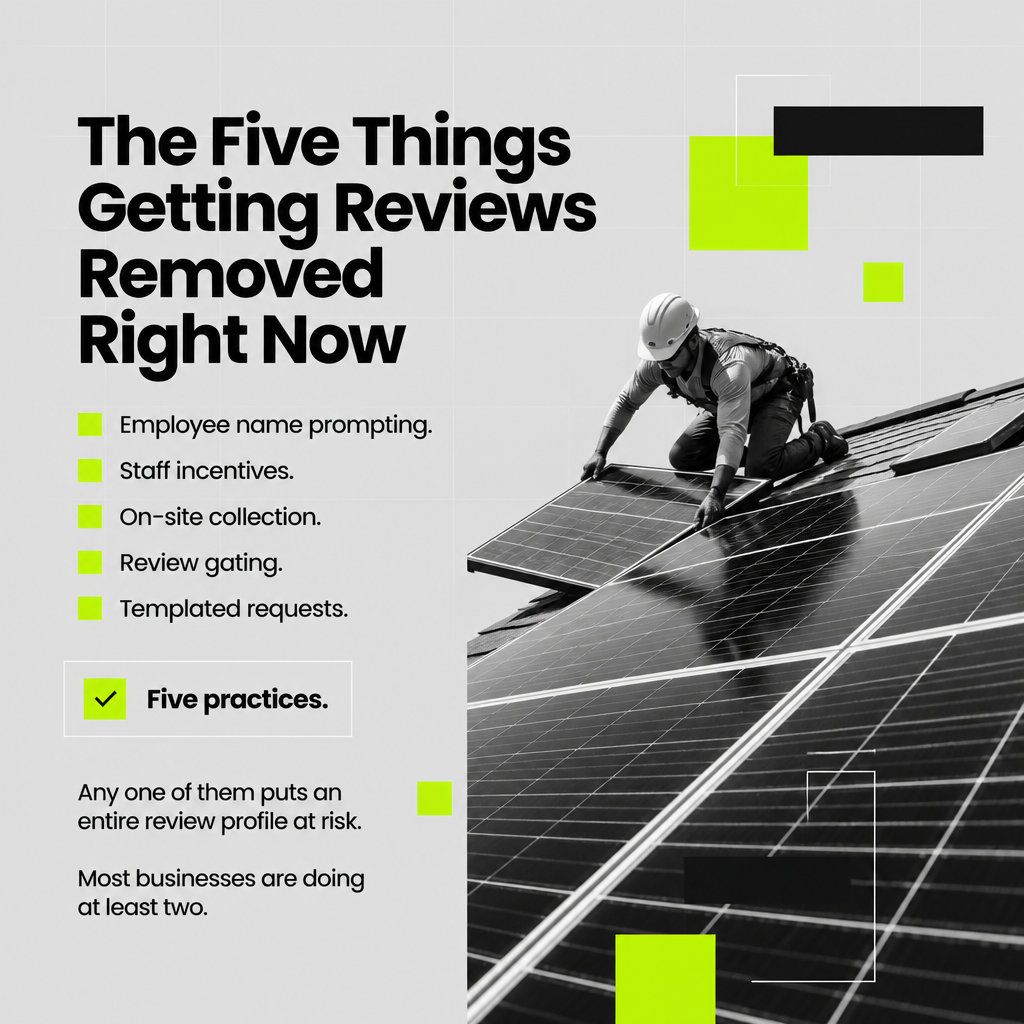
Asking customers to mention a specific employee by name in their review. This is now explicitly against policy and reviews containing prompted employee mentions are being removed.
Giving staff bonuses or incentives tied to the number of reviews received. Google considers this an indirect incentive for the customer, which makes the review inauthentic by their definition.
Collecting reviews on-site, on the business's own Wi-Fi. Google can detect when reviews are submitted from the same network as the business and is shadow-banning these.
Review gating. This is the practice of sending customers to an intermediate page that asks whether their experience was good or bad before directing them to Google. Positive experiences get sent to Google. Negative ones get sent to an internal feedback form. This has been against policy for years and is now being actively enforced.
Templated review requests that generate suggested review text for the customer to submit. Softwares that auto-generate review copy based on attributes the customer selects produce reviews that sound identical across a business's profile. Google is now identifying and removing these at scale.
Key points:
Employee name prompting, staff incentives, on-site collection, review gating, and templated requests are all now enforced violations
Businesses do not need to be doing all five: any one of them puts the entire review profile at risk
Agencies running these practices on behalf of clients are the ones who will lose accounts when reviews start disappearing

How to Get Reviews That Actually Stick
The businesses that are not losing reviews have one thing in common: they are asking for feedback in a straightforward, open-ended way without coaching the customer on what to say.
Send the same review request to every customer. No personalised keyword prompts, no suggested phrases, no template for them to fill in. Just a direct ask for their honest feedback with a link to leave a review on Google.
Keep the request open-ended. Do not reference a specific employee. Do not tell them what to write. The review should reflect the customer's genuine experience in their own words. That is exactly what Google wants to see and exactly what survives enforcement.
Do not incentivise the review. No discounts, no prize draws, no charitable donations tied to leaving a review. Even incentives for a good cause are now considered a policy risk by Google. The review needs to be motivated by the customer's experience, nothing else.
Send requests individually, not in bulk automation blasts that look like a campaign. Personalised outreach converts better and does not trigger the pattern detection that bulk sends can.
Key points:
Open-ended, direct review requests with no scripted content are the only fully compliant approach
No incentives of any kind: discounts, entries, or charitable donations all carry policy risk
Personalised individual outreach performs better and avoids the detection patterns that bulk sends trigger
The review must reflect the customer's genuine experience in their own words

The One Thing Most Businesses Get Wrong With Volume
Even if the request itself is compliant, the pattern of how reviews arrive matters enormously.
Google looks at a business's historical review velocity. If a business has been averaging three reviews a week for six months and suddenly receives forty reviews in five days, that spike is a red flag regardless of how those reviews were obtained. The reviews will be filtered more aggressively and many will not stick.
The right approach is to look back at a business's review history over the past six months, identify their average weekly volume, and then build a review generation process that produces a modest, consistent increase above that baseline over a sustained period. Not a campaign. Not a blitz. A drip.
If a business is averaging five reviews a week and the goal is to reach eight, the process should be designed to generate eight reviews a week consistently for several months, not eighty reviews in the first two weeks. Slow and steady is not just a cliché here. It is the technical requirement for reviews to survive Google's filtering.
Key points:
Google assesses review velocity against historical patterns: sudden spikes trigger filtering regardless of review quality
A compliant review process builds gradually above the existing baseline, not in a sharp campaign
Identify average weekly review volume first, then design the process to grow it steadily
Reviews that arrive in a natural, consistent pattern are significantly less likely to be removed

What to Do Next
For solar installers, reviews are not a nice-to-have. They are a core part of how you rank locally, how much trust a homeowner arrives with when they contact you, and how competitive your map pack position is relative to the other installers in your area.
The businesses that are going to benefit from the current enforcement wave are the ones that were already doing this correctly. Consistent, open-ended, natural review generation with no gating, no incentives, and no templated content. For the businesses that were not, the window to sort it out before the damage compounds is now.
If you want to understand how Google review generation sits inside a broader local acquisition system for solar installers, take a look at how we approach it at Orvanti.
Key points:
Reviews directly affect map pack position, homeowner trust, and close rates: they are a commercial asset
The enforcement wave is an opportunity for businesses doing this correctly to pull ahead of those that are not
Open-ended, natural, consistently paced review generation is the only fully compliant approach going forward
The full local acquisition system including review generation is at orvanti.ai/solar-lead-system


Why Choose Orvanti?
Expertise You Can Trust
Our team brings years of industry experience to deliver high-quality ads, conversion and prequalification systems
Tailored Approach
We craft customised strategies that align with your unique business needs and financial objectives.
Data-Driven Insights
Our cutting-edge analytics and financial modeling ensure informed decision-making for long-term success.
Proven Results
We have a track record of helping businesses enhance financial efficiency, manage risks, and achieve their goals.