

Table of Contents
The Two Halves of a Solar Marketing System
Layer One: The Foundation
Your Website and SEO
Your Google Business Profile
Google Reviews and Trust Signals
Layer Two: Driving Traffic
The Prequal Funnel
Google Ads and Meta Ads
Local SEO as a Traffic Channel
Automated Social Media
Brand Building in 2026
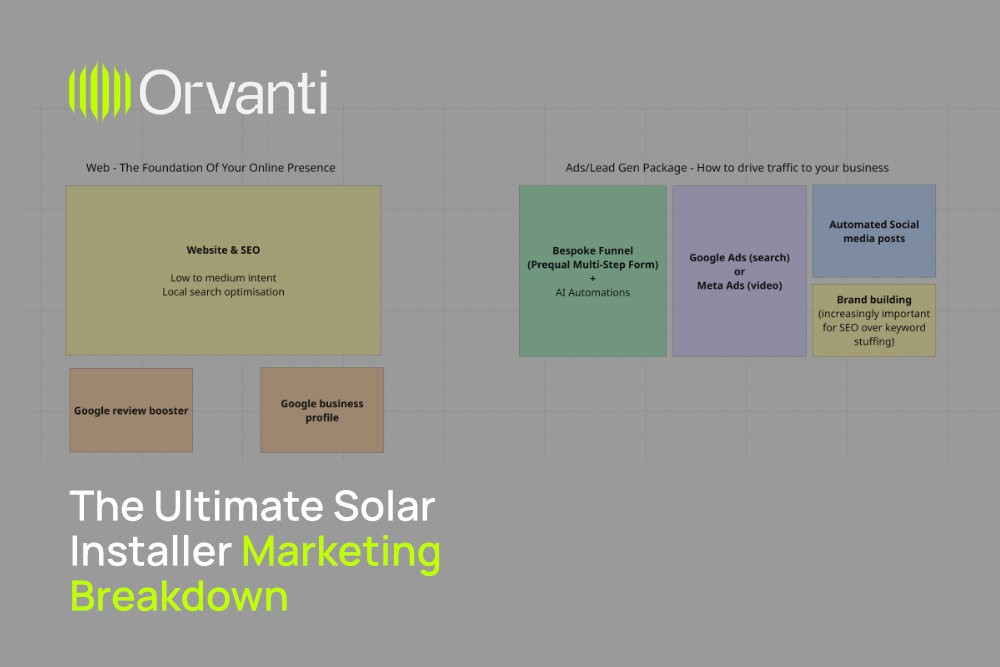
How It All Connects
The Two Halves of a Solar Marketing System
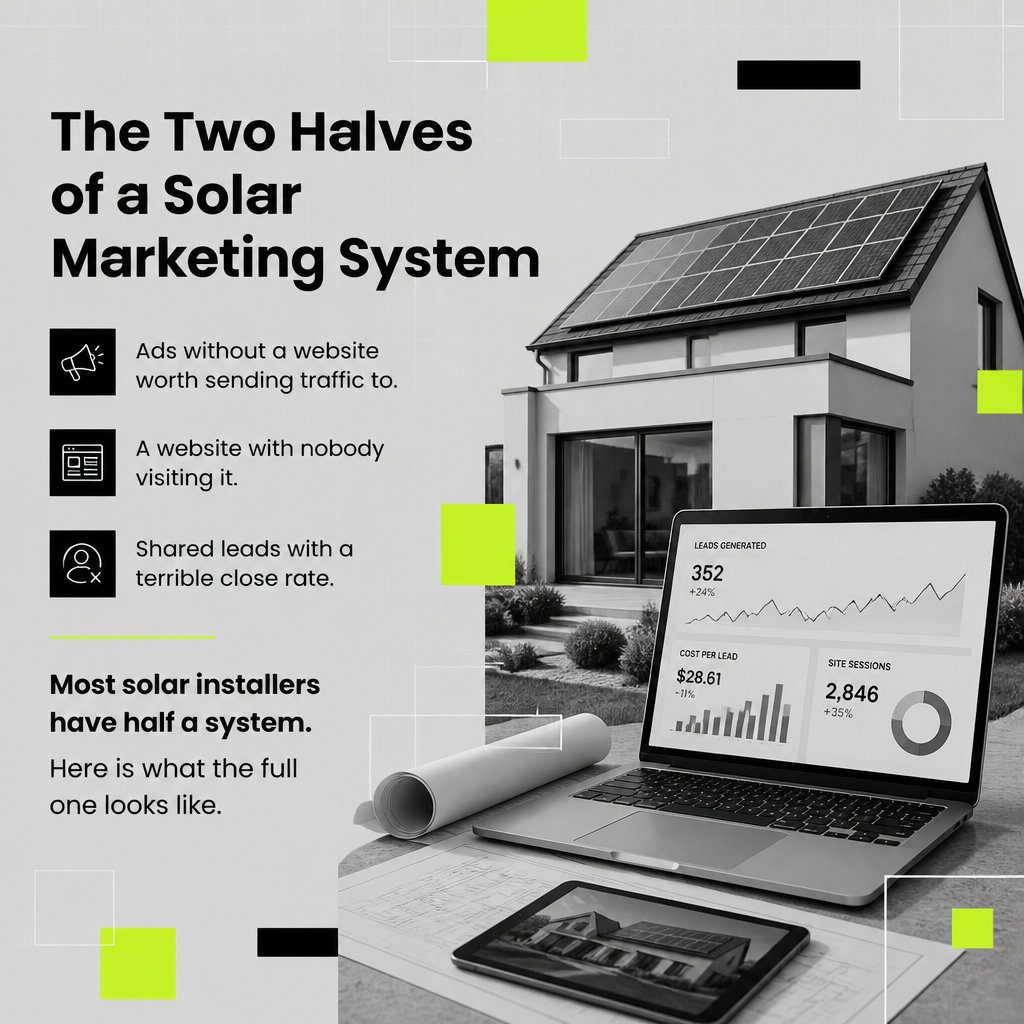
Most solar installers either have no marketing system at all or they have half of one.
They run Google Ads without a website worth sending traffic to. Or they have a decent website with nobody visiting it. Or they are paying for leads from a shared platform and wondering why the close rate is terrible.
A properly built solar marketing system has two distinct layers that work in sequence. The foundation comes first. Traffic comes second. Build them in the wrong order and you are pouring water into a bucket with no base.
This is the full breakdown of what that system looks like in 2026.
Key points:
A solar marketing system has two layers: foundation and traffic
Building traffic before the foundation is in place wastes budget and produces poor results
Most installers have one layer or neither, rarely both done properly
The sequence matters as much as the components
Layer One: The Foundation
Think of your online foundation the way you would think about a solar system installation. You would not fit panels to a roof that has not been surveyed, structurally assessed, and confirmed as fit for purpose. You check the foundation first because everything built on top of it depends on it being solid.
Your online foundation works the same way. Before you spend a pound on advertising, before you think about social media, before you start chasing leads, the infrastructure underneath needs to be in place and working properly. That means your website, your Google Business Profile, and your review presence.
Get these right and every pound you spend on traffic later works harder. Get them wrong and you are advertising your way into a leaky funnel.
Key points:
The foundation must come before traffic investment, not alongside it or after
Website, Google Business Profile, and reviews are the three pillars of the foundation
A solid foundation multiplies the return on every traffic channel built on top of it
Skipping this step is the single most common reason solar marketing spend underperforms
Your Website and SEO
Your website is the only corner of the internet you own outright. Google can change its algorithm. Meta can change its ad policies. Review platforms come and go. Your website is yours.
For a solar installer, a website needs to do two things well. First, it needs to convert the visitors it already gets: clear service descriptions, real case studies, visible trust signals, and a frictionless next step. Second, it needs to rank for the searches your potential customers are making.
That second part is SEO. And for local installers, SEO means building a page for every service you offer in every area you cover. Solar panel installation Worcester. Battery storage Droitwich. EV charger Kidderminster. Each page targets a specific search from a real homeowner with buying intent. A homepage cannot do this job. Only dedicated pages can.
The website is low to medium intent traffic. The homeowner searching "solar panel installation Worcestershire" is researching. They are not necessarily ready to book today. But they are in the funnel and a well-built website with strong local SEO keeps you visible throughout their entire decision journey.
Key points:
Your website is the only digital asset you own: everything else is rented
It needs to convert existing visitors and generate new ones through SEO simultaneously
One page per service per location is the structure that generates local search visibility
Website and SEO serves low to medium intent traffic: people researching before they are ready to commit
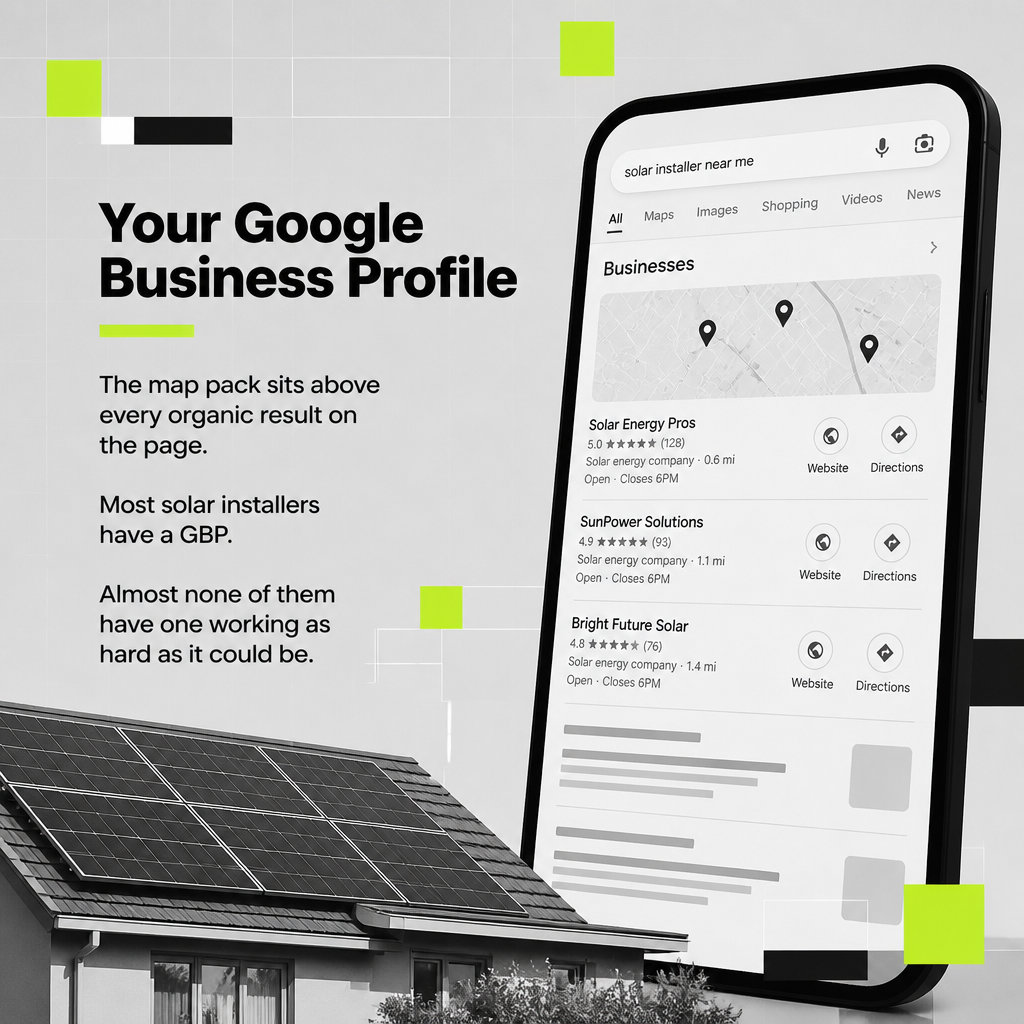
Your Google Business Profile
Your Google Business Profile is not a directory listing. It is a lead channel.
The map pack, the three businesses that appear above organic results when someone searches for a local service, captures its own share of clicks independently of the standard search results. Appearing in that pack for searches like "solar installer Worcester" is one of the highest-leverage positions a local installer can hold.
Getting there requires treating your GBP as an active part of your marketing, not a form you filled in once. Regular posts, photos of real installs, accurate and complete service information, and consistent business details that match your website exactly. Google cross-references everything. Inconsistencies cost you position.
An optimised, actively managed GBP is one of the lowest-cost, highest-return investments available to a local solar business. Most installers have one. Almost none of them have one that is working as hard as it could be.
Key points:
The map pack appears above organic search results and generates independent click share
GBP ranking is driven by activity, completeness, and consistency across the web
Business details must be identical on your GBP, website, and every directory
An actively managed GBP is one of the best returns available in local marketing
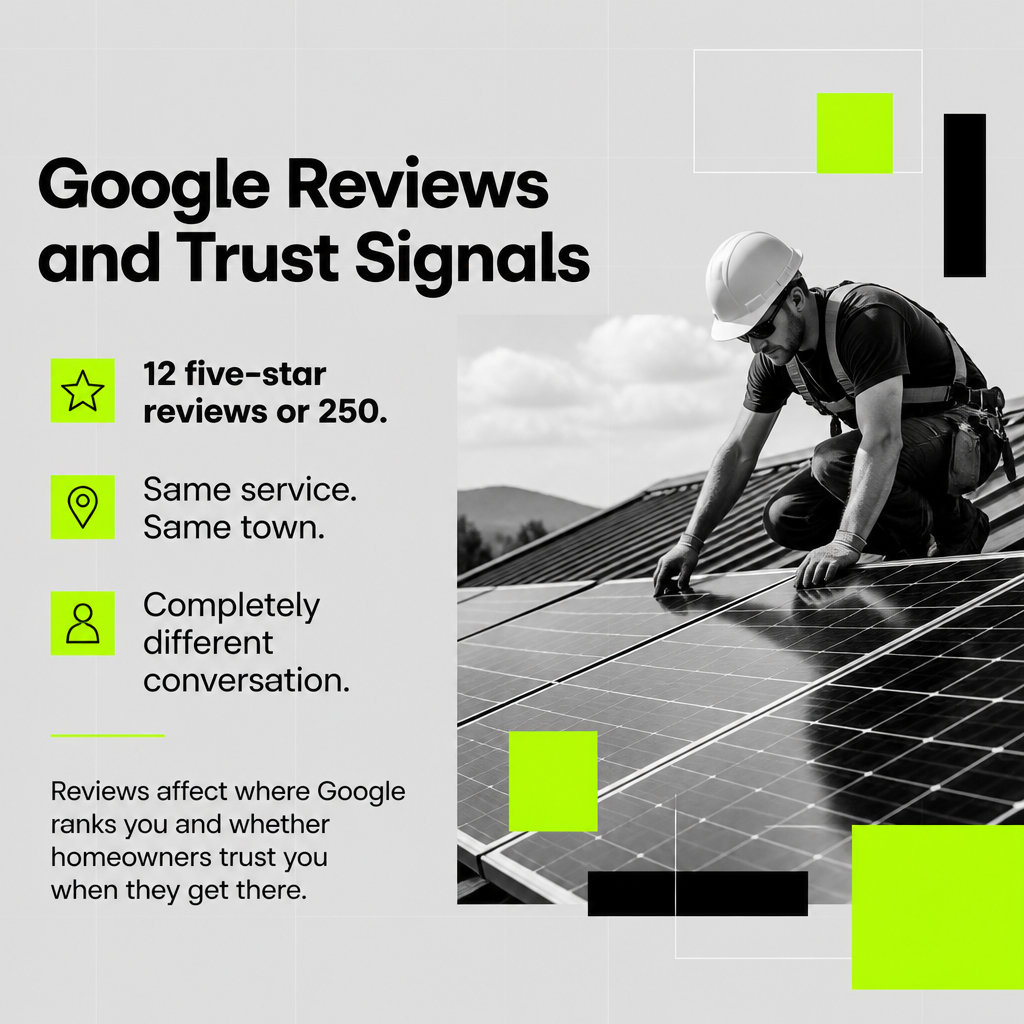
Google Reviews and Trust Signals
A homeowner choosing between two solar installers will look at reviews before they look at almost anything else. 12 five-star reviews versus 250 five-star reviews is not a marginal difference in perception. It is a different conversation entirely.
Reviews do two jobs simultaneously. They influence the decision of every homeowner who finds you. And they directly affect where Google ranks you in local search. More reviews, more recent, with natural varied language, signals an active and trusted business. That signal moves your map pack position upward over time.
The most effective way to build review volume is to make asking for reviews a standard part of every completed job. Not a campaign you run once a year. A consistent behaviour baked into how your team wraps up every installation. A text message the day after the job is done with a direct link and a simple ask for honest feedback. No script. No incentive. No suggested phrases. Just a genuine request from a business that did good work.
The same principle applies to Trustpilot, Checkatrade, and any other platform your customers might look at. Consistent, natural, multi-platform review growth is one of the clearest trust signals available, both to homeowners and to Google.
Key points:
Reviews affect homeowner decisions and local search rankings simultaneously
Volume and recency matter: consistent growth over time is more valuable than periodic spikes
Make review requests a daily operational habit, not a one-off campaign
Multi-platform review presence across Google, Trustpilot, and Checkatrade compounds trust signals
Layer Two: Driving Traffic
Once the foundation is in place, the job becomes getting the right people in front of it.
Traffic for a solar installer comes from several channels and each one attracts a different type of prospect at a different stage of their decision. The goal is not to pick one channel and ignore the rest. The goal is to build a system where multiple channels feed the same funnel, each one contributing leads at different intent levels and different costs.
All of that traffic points at one thing: a pre-qualification form that filters for the prospects worth having a conversation with.
Key points:
Multiple traffic channels serve different intent levels and different prospect types
No single channel does the whole job: a system uses several working together
All traffic should point toward a qualification funnel, not directly to a generic contact form
The foundation must be in place before traffic investment makes sense
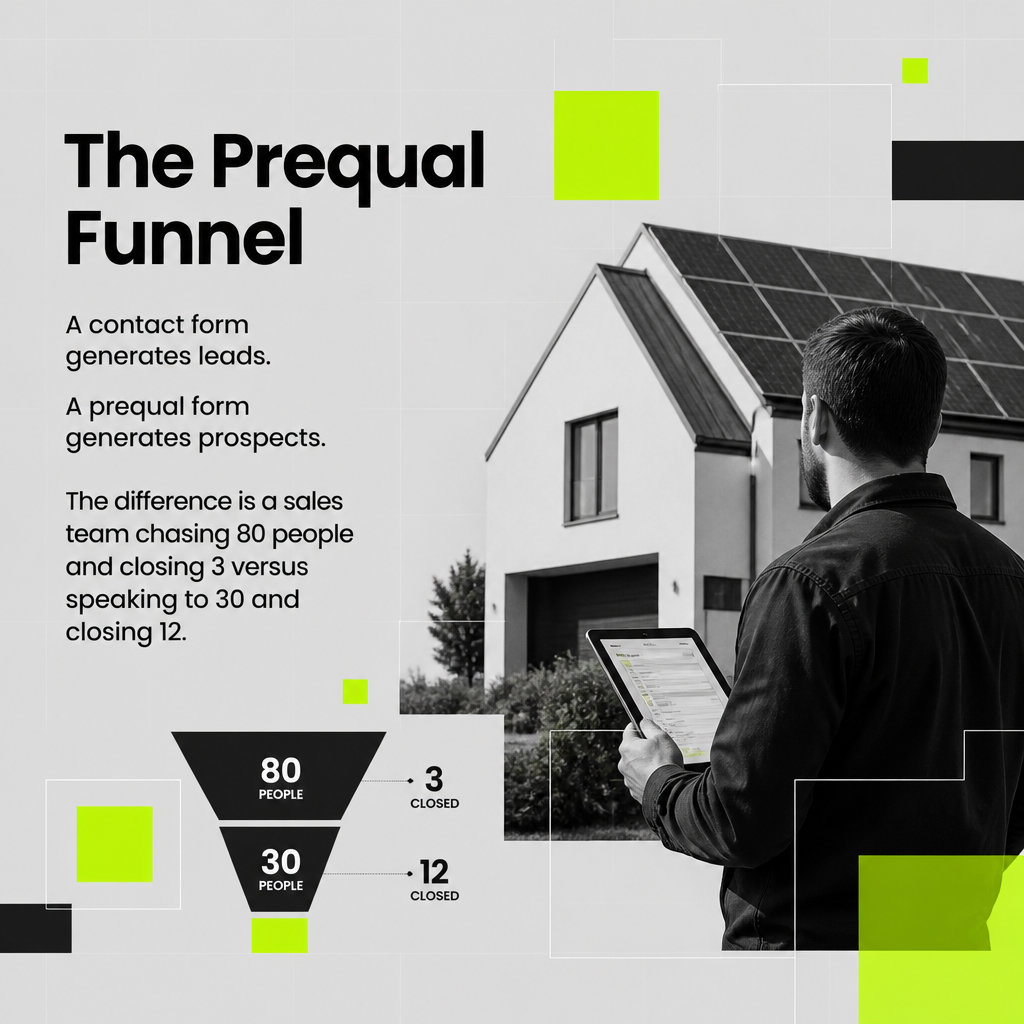
The Prequal Funnel
A contact form that asks for a name, email, and phone number generates leads. A pre-qualification form that asks about property type, ownership, roof orientation, budget, and timeline generates prospects.
The difference between those two things is the difference between a sales team chasing 80 people a month and closing 3, versus speaking to 30 people a month and closing 12. The leads look cheaper in the first scenario. The cost per sale is significantly lower in the second.
Every traffic channel in this system feeds the same prequal form. The form does the first layer of qualification before anyone picks up the phone. AI automations handle the immediate follow-up: a text within minutes of submission, a confirmation, a booking link for a survey. Speed to lead in solar is a genuine competitive advantage. Most installers take days to respond. A business that responds in minutes is a different proposition entirely.
Key points:
A prequal form filters for budget, ownership, timeline, and intent before the sales team is involved
Fewer qualified leads consistently outperform more unqualified ones across every commercial metric
AI automation handles immediate follow-up: response within minutes is a competitive differentiator
Every traffic channel should feed the same funnel, not separate contact forms
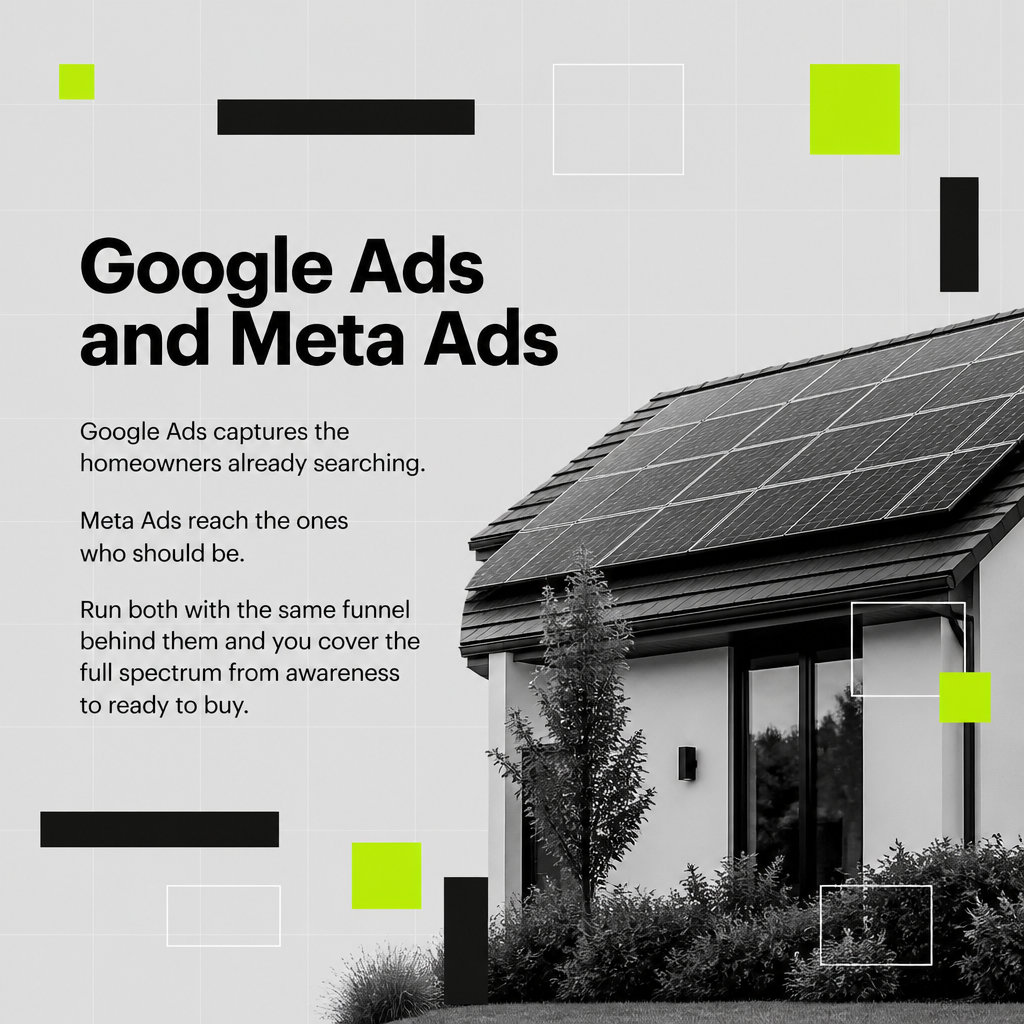
Google Ads and Meta Ads
Google Ads captures high-intent traffic: homeowners actively searching for solar installation right now. These are the people furthest along in their decision. The cost per lead is higher but the conversion rate is better and the sales cycle is shorter.
Meta Ads work differently. Video content on Facebook and Instagram reaches homeowners who are not yet searching but are the right demographic to be interested. Done well, a short before-and-after video of a real install in a recognisable local area stops the scroll and plants the idea. These leads are lower intent on arrival but with the right qualification funnel and follow-up sequence they convert into surveys and jobs.
The two channels complement each other. Google Ads captures demand that already exists. Meta Ads create demand that does not yet. Running both with a shared prequal funnel and a shared follow-up sequence gives a solar installer coverage across the full spectrum of buyer readiness.
Key points:
Google Ads targets high-intent homeowners already searching: higher cost, higher conversion
Meta video ads reach the right demographic before they are actively searching: lower intent, longer cycle
Both channels feed the same prequal funnel and follow-up sequence
Running both gives coverage across the full spectrum from awareness to ready-to-buy
Local SEO as a Traffic Channel
Local SEO is the long-term traffic channel that compounds without ongoing cost per click. A service location page that reaches position one for "solar battery storage Worcester" generates leads every month without an ad budget behind it. Once it is ranking, it keeps ranking.
The trade-off is time. SEO takes three to six months to show meaningful movement. It is not the right channel if you need leads next week. It is the right channel if you want to build a position in your local market that is difficult for competitors to unseat and does not require continuous spend to maintain.
For content ideas, Google News is an underused resource. Searching "solar panels" surfaces the topics homeowners are reading about right now: energy price changes, new government incentives, battery technology updates. Each one is a blog post opportunity that connects your website to current conversations and signals to Google that your content is timely and relevant.
Key points:
Local SEO generates leads without ongoing cost per click once pages are ranking
Three to six months for meaningful movement: a long-term channel, not a quick fix
Google News surfaces current solar topics worth writing about to keep content timely
Service location pages (service plus town) are the core content structure for local SEO
Automated Social Media
Consistent social media presence contributes to brand recognition, trust signals, and in an indirect but real way, SEO. A business that appears active across multiple platforms looks different to Google than one with no social footprint.
For solar installers, the most effective social content is straightforward: real installs, real results, real customer stories. Before and after images from a Droitwich installation get shared by the homeowner, seen by their neighbours, and create organic reach in exactly the geography you serve.
Automated social posting removes the friction that makes most businesses inconsistent. Set up a system that pulls current solar topics from Google News, schedules posts across Facebook, Instagram, and LinkedIn, and maintains a consistent posting cadence without requiring manual effort every day. The content does not need to be sophisticated. It needs to be consistent, local, and real.
Key points:
Consistent social activity builds brand recognition and contributes to broader trust signals
Real local install content generates organic sharing in exactly the areas you serve
Automated posting maintains consistency without daily manual effort
Google News provides a continuous stream of relevant solar topics to post about
Brand Building in 2026
Something has shifted in how Google and AI tools decide which businesses to surface and recommend.
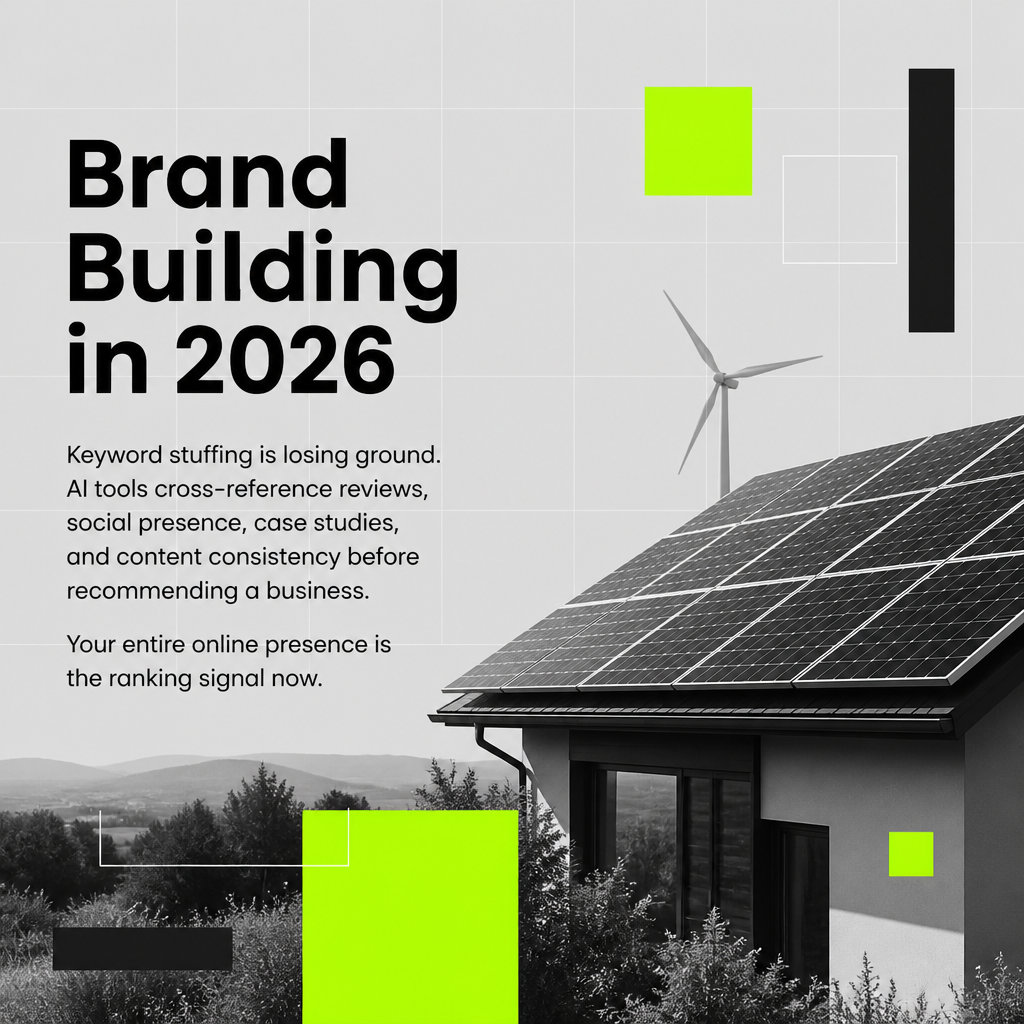
Keyword stuffing, the practice of loading pages with search terms to manipulate rankings, is becoming less effective as Google gets better at understanding context and intent. What is becoming more effective is genuine brand presence: a business that exists coherently across multiple platforms, has real customers talking about it publicly, produces content that answers real questions, and shows up consistently over time.
This matters because AI tools like ChatGPT and Google's AI Overviews are increasingly being used at the research stage of the solar buying journey. These tools do not just look at your website. They cross-reference everything they can find. A business with real case studies, consistent reviews, active social presence, and substantive local content is significantly more likely to be recommended than one that has only optimised its title tags.
Brand building is not separate from SEO in 2026. It is what SEO is becoming. The solar installers who understand this early and invest in it consistently will hold positions that are genuinely hard to compete with in three years. The ones that do not will wonder why their rankings are slipping despite doing everything the old way correctly.
Key points:
Keyword stuffing is losing ground to genuine brand presence as a ranking signal
AI tools cross-reference reviews, social presence, case studies, and content consistency, not just websites
Real case studies, active review growth, and consistent content are the new currency of local authority
Brand building is not a separate activity from SEO: it is what SEO is becoming
How It All Connects
The system works because every component feeds the next one.
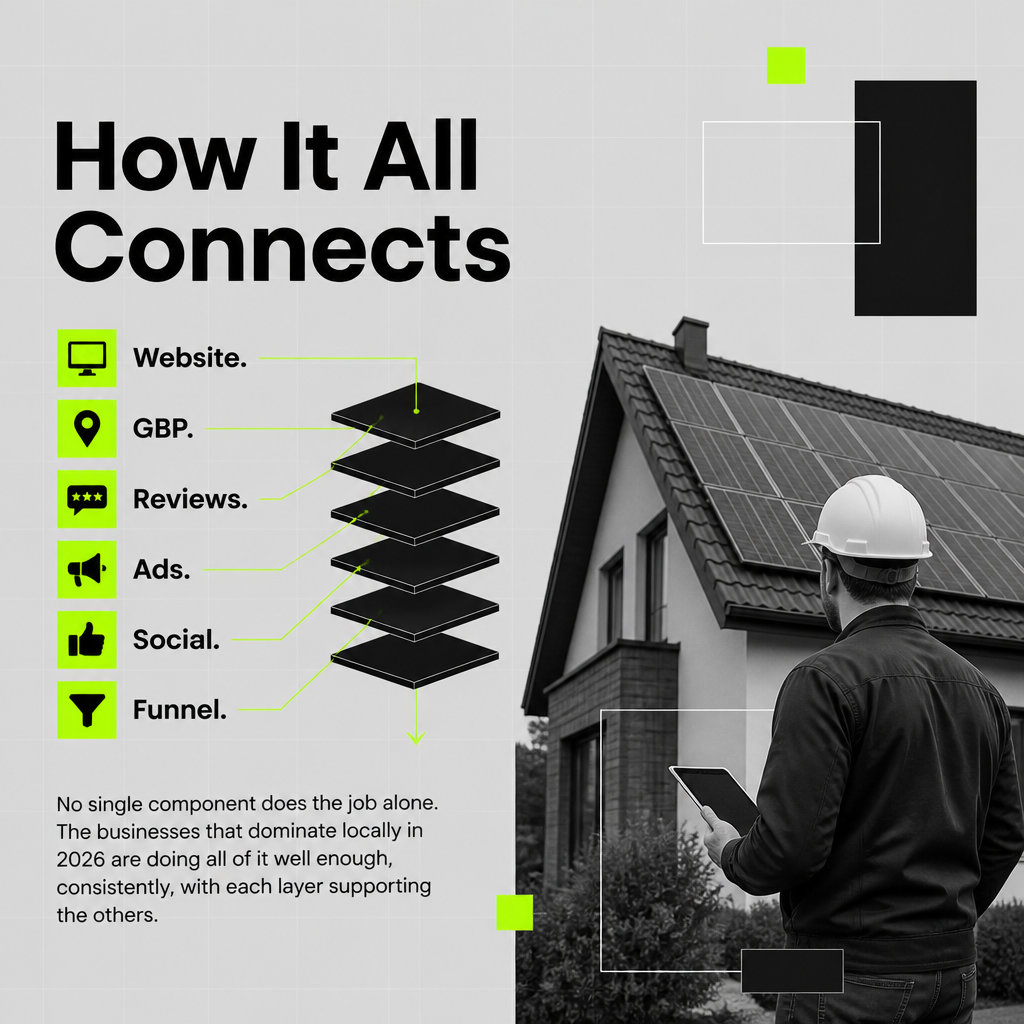
A strong website with local SEO generates organic traffic. An optimised GBP captures map pack clicks. Consistent reviews build the trust that converts both into enquiries. Google Ads and Meta Ads add paid traffic on top. Automated social keeps the brand visible between touchpoints. All of it points at a prequal funnel that filters for the right prospects before the phone rings.
No single component does the job alone. A solar installer spending money on Google Ads without a converting website is wasting budget. An installer with a great website and no reviews is losing homeowners at the trust stage. An installer with strong reviews and no traffic channels is leaving leads on the table.
The businesses that dominate locally in 2026 are not doing one thing very well. They are doing all of it well enough, consistently, with each layer supporting the others.
If you want to see how we build this system specifically for solar installers, take a look at how Orvanti approaches it here.
Key points:
Every component in the system feeds the next one: none of them work as well in isolation
The prequal funnel is the point where all traffic channels converge
Consistent execution across all layers is what separates area dominance from average results
The full system built specifically for solar installers is at orvanti.ai/solar-lead-system


Why Choose Orvanti?
Expertise You Can Trust
Our team brings years of industry experience to deliver high-quality ads, conversion and prequalification systems
Tailored Approach
We craft customised strategies that align with your unique business needs and financial objectives.
Data-Driven Insights
Our cutting-edge analytics and financial modeling ensure informed decision-making for long-term success.
Proven Results
We have a track record of helping businesses enhance financial efficiency, manage risks, and achieve their goals.