


Table of Contents
How Attention Is Distributed Online
Why Attention Functions as a Currency
What the Algorithms Are Optimising For
What This Means for the Content You Produce
Why This Is What Orvanti Does

How Attention Is Distributed Online
Almost all online attention is now distributed by algorithms. Google decides which websites appear for a search. Meta decides who sees a given video. Google's map pack decides which local businesses appear above the rest. These systems sit between every business and every potential customer.
This means modern marketing has two audiences, not one. The first is the algorithm that controls distribution. The second is the person on the other side of it. You do not reach the person unless the algorithm decides to show you to them first.
Content and distribution feed each other. Because attention is the currency, content that captures attention gets rewarded with more distribution, which captures more attention, which snowballs. The catch is what the algorithm actually measures. It rewards the quantity of attention consumed, not the quality of it. Content that holds a lot of attention wins distribution whether or not that attention was well spent. So producing excellent content is not enough on its own. It has to be excellent in a way that captures attention at volume, and understanding that distinction is now a core part of marketing rather than a technical afterthought.
Key points:
Online attention is distributed by algorithms across search, social, and local platforms
Marketing now has two audiences: the algorithm first, the person second
The relationship is symbiotic: content that captures attention earns more distribution, which snowballs
The catch is that algorithms reward the quantity of attention consumed, not the quality, so content must capture attention at volume

Why Attention Functions as a Currency
Attention behaves like a currency online because of a basic supply and demand imbalance.
The volume of content being produced is effectively unlimited. The amount of human attention available to consume it is fixed. There are a finite number of hours in a day and a finite number of things any person can read or watch. When supply is unlimited and demand is fixed, the fixed resource is the valuable one. Attention is that resource.
The platforms are built on this. Their revenue comes from selling attention to advertisers, which means capturing and holding attention is their core commercial objective. Their algorithms are designed to maximise engagement because engagement is the product they sell. Content that helps them hold attention gets distributed. Content that does not is deprioritised.
This is why aligning with what the algorithm wants is not a cynical exercise. The platform's incentive is to surface content that keeps people engaged, and engaging content is also what serves the audience. The two objectives largely overlap.
Key points:
Content supply is effectively unlimited while human attention is fixed, making attention scarce and therefore valuable
Platforms generate revenue by selling attention, so capturing it is their primary objective
Algorithms maximise engagement because engagement is what platforms monetise
The platform's interest in engaging content and the audience's interest in it largely align
What the Algorithms Are Optimising For
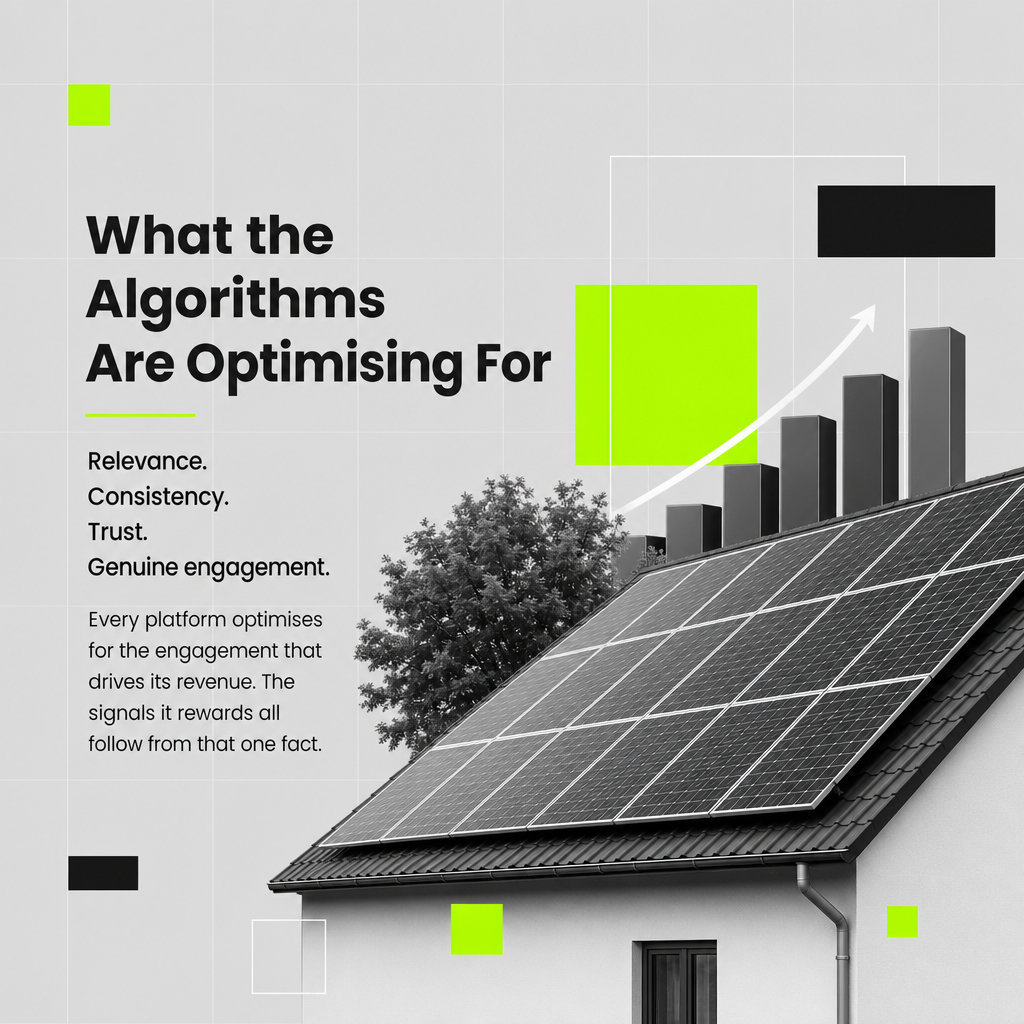
Each platform optimises for the engagement that drives its revenue, and the signals it rewards follow from that.
Google rewards content that answers the searcher's question, because a satisfied searcher returns to Google. That means relevance to the search, depth, accuracy, and signals that the business is legitimate and trusted. Meta rewards content that holds attention in the feed, which means watch time, interaction, and relevance to the viewer. Local algorithms reward consistency, proximity, review signals, and the completeness and accuracy of a business profile.
Across all of them, a few common signals recur: relevance, consistency, trust, and genuine engagement. These are the things that indicate, to the platform, that surfacing your content will hold attention rather than lose it.
This is also why approaches that attempt to manipulate the signals rather than genuinely satisfy them have become less effective. Keyword stuffing, low-quality link building, and artificially generated reviews are attempts to fake the signals the algorithm reads. As the systems have improved at detecting manipulation, the reliable approach has shifted toward producing content that genuinely meets the criteria. Manipulation degrades the quality of what the platform serves, which is why platforms have a strong incentive to detect and penalise it.
Key points:
Each platform optimises for the engagement that drives its revenue
Google rewards relevance and trust; Meta rewards watch time and interaction; local algorithms reward consistency and review signals
Relevance, consistency, trust, and genuine engagement are the recurring signals across platforms
Manipulating signals has become less effective as detection has improved; genuinely meeting the criteria is the durable approach

What This Means for the Content You Produce
If distribution depends on satisfying these signals, then the practical job of marketing is producing content and presence that does so, consistently and at scale.
For a local business, that means a website that genuinely answers the questions its customers search for, a complete and active Google Business Profile, a consistent flow of genuine reviews, a social presence that maintains visibility, and real proof such as case studies that demonstrate the business is legitimate and active. Each of these feeds the signals the algorithms read.
Volume and consistency matter because the algorithms weigh activity over time. A single well-optimised page is worth less than a steady output of relevant content. A handful of reviews is worth less than a consistent stream of them. The systems are assessing whether a business is genuinely active and trusted, and that assessment is built from sustained signals rather than one-off efforts.
The implication is that marketing in this environment is an ongoing operation, not a project with an end date. The businesses that earn the most distribution are the ones producing the right signals continuously.
Key points:
The practical job of marketing is producing content and presence that satisfies the algorithm's signals
Website depth, an active GBP, consistent reviews, social presence, and real case studies all feed those signals
Volume and consistency matter because algorithms weigh sustained activity over one-off efforts
This makes marketing an ongoing operation rather than a finite project

Why This Is What Orvanti Does
Orvanti exists to handle this operation on behalf of solar installers.
Producing the volume of content, presence, and trust signals that the algorithms reward, consistently and over time, is a discipline in itself. It also changes as the platforms update their systems. For a solar installer whose work is designing and fitting solar systems, building this in-house means either a significant time cost or hiring for a skill set that sits outside their core business.
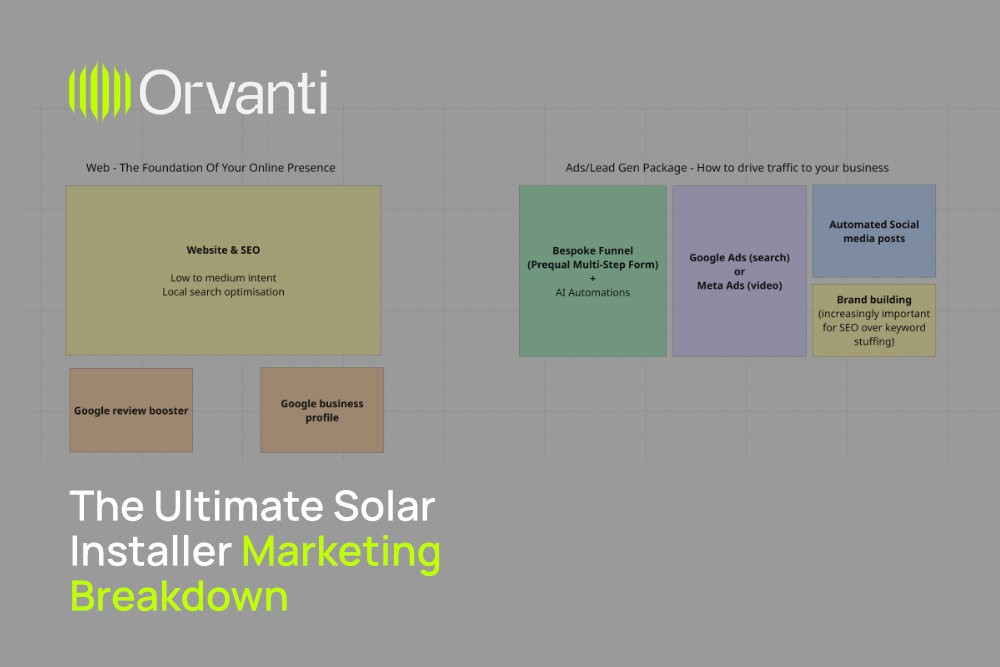
What we do is create and scale that content and visibility. The website and local SEO, the service and location pages, the review generation, the social output, and the brand signals that increasingly carry more weight than keyword optimisation. The objective is to build a presence that the distributing systems consistently choose to surface, so that homeowners searching for solar are routed toward the installer rather than past them.
The work is continuous by necessity, because the signals that earn distribution are built from sustained activity. That is the part we take on, so the installer can stay focused on the installs.
If you want to see how the full system is structured, take a look at our solar lead system here.
Key points:
Producing the signals algorithms reward, at scale and consistently, is a discipline that sits outside an installer's core work
The systems change as platforms update, adding to the ongoing cost of doing it in-house
Orvanti creates and scales the content, presence, and trust signals that earn distribution
The full system is at orvanti.ai/solar-lead-system

Why Choose Orvanti?
Expertise You Can Trust
Our team brings years of industry experience to deliver high-quality ads, conversion and prequalification systems
Tailored Approach
We craft customised strategies that align with your unique business needs and financial objectives.
Data-Driven Insights
Our cutting-edge analytics and financial modeling ensure informed decision-making for long-term success.
Proven Results
We have a track record of helping businesses enhance financial efficiency, manage risks, and achieve their goals.