

If you’re a solar installer (or a solar lead-gen business) trying to win organic traffic in 2026, here’s the truth:
No one can guarantee you’ll rank #1 in Google.
Google’s results change constantly, competitors react, and the SERP (search results page) isn’t “10 blue links” anymore — it’s a mix of maps, Reddit threads, comparison pages, AI overviews, videos, and local packs.
What is realistic is building as many winning conditions as possible so your website has the highest chance of ranking for the keywords that actually drive revenue.
At Orvanti, we see this every day. We build conversion-focused websites, solar landing pages, and pre-qualification systems that turn traffic into booked surveys — and SEO only works when the site is structured to convert the right people, not just attract clicks.
This is the step-by-step SEO roadmap we’d follow to build a solar brand’s visibility in 2026.
Reality Checks Before You Start
1) Some keywords aren’t worth chasing
If you’re trying to outrank national comparison sites and enterprise brands for ultra-competitive head terms overnight, that’s usually a bad ROI decision.
You’re better off targeting high-intent local and service-specific terms where you can actually win.
2) Ranking is one thing — staying there is another
Even if you hit #1, competitors will copy what’s working and try to out-publish you, out-link you, and out-update you.
SEO is not “set and forget.” It’s a compounding system that needs maintenance.
3) You don’t need #1 for everything
Most solar businesses have hundreds or thousands of possible keywords across services, locations, and questions.
The real skill isn’t “doing SEO.”
It’s choosing what to prioritise so effort turns into installs.
Step 1 — Identify Your “Business-Driving” Keywords
Start with a clean slate and ask:
What would a ready-to-buy homeowner type into Google if they wanted what we sell?
For solar, your core keyword buckets usually look like this:
A) Brand searches (you want to own these)
your company name + “solar”
your company name + “reviews”
your company name + “finance”
B) Core service keywords (money keywords)
solar panel installation + town/city
solar installers near me
residential solar panels + location
solar battery installation + location
C) Commercial (only if you actually sell it)
commercial solar installers + location
solar for warehouses / factories / farms
D) Finance & pricing intent (high converting)
solar panels cost for 3 bed house UK
solar finance options
solar panel payback time UK
solar battery cost UK
Orvanti angle: we usually map these keywords directly to conversion journeys:
“near me / installer” keywords → fast quote / survey booking
“cost / finance” keywords → calculator + pre-qual form
“battery” keywords → dedicated battery landing page + qualification
Because ranking is pointless if the page doesn’t convert.
Step 2 — Study the SERP (What Google Thinks People Want)
For each target keyword, Google it and look at what shows up.
In 2026, you’ll often see:
Local map pack (Google Business Profiles)
“People also ask”
Reddit / forum threads
Comparison/roundup pages
YouTube videos
AI overviews
Your job is to figure out:
What’s the search intent?
What is the person actually trying to do?
What’s Google’s assumed intent?
Google reveals this by what it ranks.
Mixed intent keywords
Some keywords show a blend of page types.
Example in solar:
“best solar panels UK” might show comparisons, reviews, and brands.
“solar installers Leeds” might show local pack + service pages.
When intent is mixed, you have 3 options:
Follow the majority (match what most top results are)
Choose the best angle for your authority level
Create a “backdoor” content asset (like a roundup) to compete with bigger brands
Smaller brands often win by publishing something more useful than a generic service page — then internally linking it back to the money page.
Step 3 — Build the Best Possible Page (Format + Substance)
Once you know the intent, build the best page for it.
Match the format to intent
If top results are:
service pages → build a service page
location pages → build a location page
comparisons → build a comparison
videos → consider publishing video too
Important: word count is not the goal.
The goal is: did we fully answer what the searcher needs?
Make it conversion-first (Orvanti standard)
For solar pages, “best page” includes conversion structure, not just SEO text.
We typically bake in:
clear offer (free survey / quote / savings estimate)
trust signals (MCS, RECC, warranties, case studies)
finance section (even a simple explanation boosts conversions)
FAQs mapped to “People also ask”
fast pre-qualification (so sales only speaks to real prospects)
Step 4 — Prove Real Experience (EEAT Wins in 2026)
Google has become very good at spotting content that looks “assembled.”
To rank and convert in solar, you want pages that feel like they come from a real operator.
Experience signals that actually move the needle:
original photos of installs
screenshots of proposals / monitoring apps (with sensitive info removed)
real case studies with numbers (kWh, savings, payback)
step-by-step process (“survey → design → install → sign-off”)
named author / company accountability
published + last updated dates
If you’re writing about “solar battery savings,” show that you’ve actually installed batteries and measured outcomes.
If you don’t have experience in-house yet, use:
interviews with your installers
anonymised customer results
documented site surveys and install workflows
Step 5 — “Power Up” Your Money Pages (Topical Authority + Links)
A great page alone usually isn’t enough.
To compete, you need to build trust and authority around your revenue pages.
A) Topical authority (content clusters)
Think like Google:
Which site deserves to rank for “solar panels cost Manchester”?
Site A: one page about solar cost
Site B: a whole ecosystem:
solar cost Manchester
solar cost 3 bed house Manchester
solar finance Manchester
solar battery cost Manchester
payback time Manchester
best angle roof for solar UK (supporting)
does shading affect solar output (supporting)
Site B looks like the specialist.
Orvanti cluster model (simple)
We usually build this as:
Money Page (service/location)
↳ Support Pages (FAQs, costs, finance, objections, comparisons)
↳ all internally linked back to the money page
B) Backlinks (but in the right order)
Backlinks still matter, but the smart order is:
build clusters first
then build links to the best supporting content
pass authority to money pages via internal linking
It’s far easier to earn links to:
a useful “solar savings calculator”
a “2026 solar finance guide”
a “battery comparison breakdown”
than it is to earn links to a “Get a Quote” page.
Step 6 — The SEO Flywheel for Solar (What This Looks Like Practically)
Here’s the repeatable process we’d run for a solar brand:
Pick 1–3 high-value services (solar, battery, EV charger)
Pick your priority locations (where installs actually happen)
Build conversion-first money pages for each
Build clusters around each money page (cost, finance, FAQs, comparisons)
Internally link everything with a clear structure
Add proof: installs, results, photos, case studies
Earn links to the most useful content assets
Refresh content monthly/quarterly based on SERP changes
This is how you win in 2026 without chasing everything.
Where Orvanti Fits In
Most SEO fails because traffic turns into:
tyre kickers
unqualified enquiries
people outside service areas
people who can’t afford it
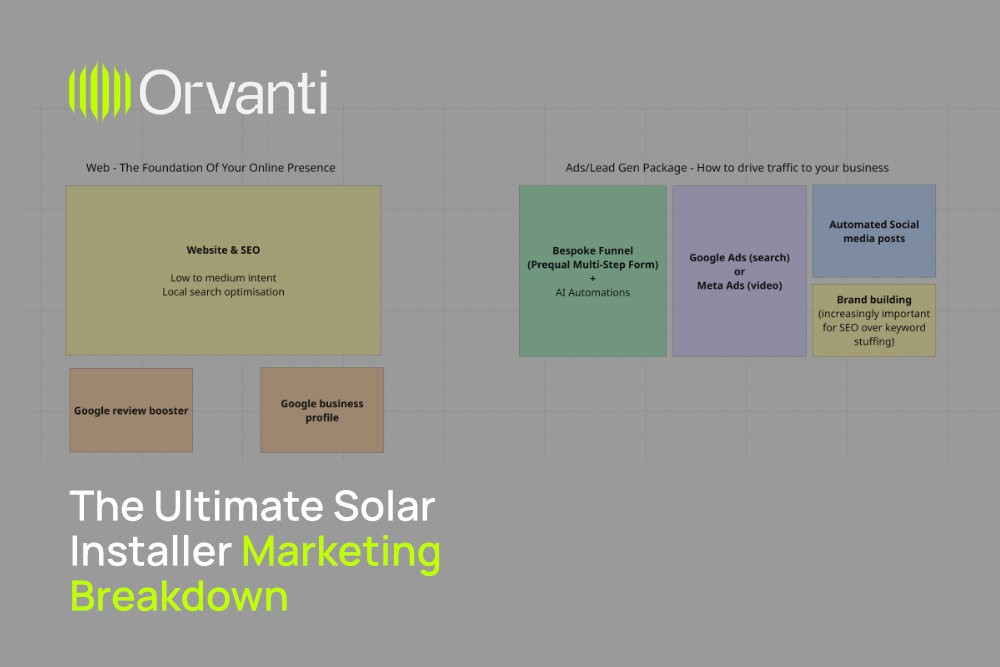
Orvanti isn’t just “SEO blogs.”
We build the full chain:
the site that ranks (SEO architecture)
the landing pages that convert (CRO)
the pre-qualification that filters (forms + logic)
the tracking so you know what’s working (calls/forms/source)
So organic growth produces installs — not noise.


Why Choose Orvanti?
Expertise You Can Trust
Our team brings years of industry experience to deliver high-quality ads, conversion and prequalification systems
Tailored Approach
We craft customised strategies that align with your unique business needs and financial objectives.
Data-Driven Insights
Our cutting-edge analytics and financial modeling ensure informed decision-making for long-term success.
Proven Results
We have a track record of helping businesses enhance financial efficiency, manage risks, and achieve their goals.