

Short Form vs Long Form Trust Levers: Why Both Matter for Service Businesses Running Paid Traffic
There are two completely different types of trust signals that operate on a website and within a company’s marketing.
Short-form trust levers.
Long-form trust levers.
They solve different problems, operate on different timelines, and require different levels of investment.
Understanding the difference is what separates websites and marketing systems that generate enquiries immediately from those that also contribute to long-term brand reputation and recognition.
For many service business owners, this is also a strategic decision.
Do you want to build a business that relies primarily on paid traffic systems like Google Ads, where you consistently generate enquiries through demand capture?
Or is your long-term vision to build a recognisable brand that homeowners already trust before they even search?
Both models work.
They simply require different investments, timelines and expectations.
Most successful service businesses eventually use a mix of both.
Short-Form Trust Levers
Designed to Convert Cold Traffic Quickly
Short-form trust levers exist for one purpose: reducing hesitation in the first few seconds.
When someone clicks an ad, they do not read your entire website.
They scan.
If the page does not immediately communicate credibility, they leave.
This is why high-converting service websites stack trust signals directly in the hero section.
Examples include:
5-star customer ratings
authority logos and accreditations
quick value bullets
government or regulatory approval badges
finance availability
insurance guarantees
years of experience statements
The screenshot above shows a good example of this structure.
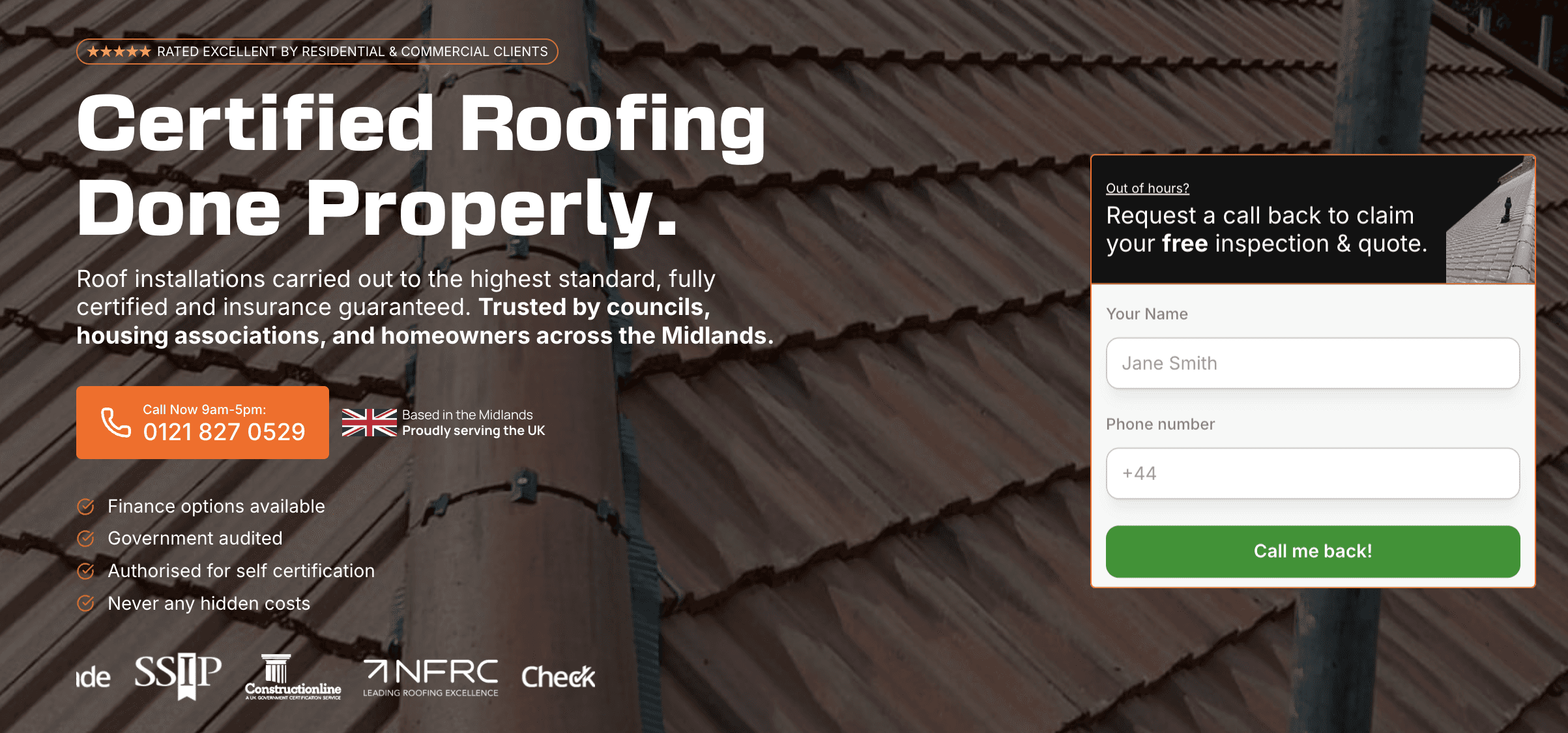
Immediately visible are:
a 5-star rating banner
a strong outcome-based headline
authority references (councils and housing associations)
finance availability
certifications
compliance badges
These elements work because they answer the visitor’s subconscious questions instantly.
“Is this company legitimate?”
“Do other people trust them?”
“Are they properly accredited?”
“Will this be expensive or risky?”
Short-form trust signals remove friction before the user even reads the rest of the page.
Why This Matters for Google Ads
When someone searches:
“roof replacement Birmingham”
“solar installers near me”
“new windows cost UK”
They already have intent.
Your job is not to educate them on the industry.
Your job is to prove quickly that your company is the safest choice.
This is why high-converting landing pages prioritise:
trust badges
testimonials
short authority statements
quick benefit bullets
simple call-to-action forms
These are conversion trust levers, not brand storytelling.
They work extremely well when traffic is coming from paid search.
The Value Stacking Technique
Another powerful short-form trust method is value stacking.
Instead of describing your service in long paragraphs, you present a quick list of protections, guarantees and benefits.
For example:
Fully insured installation
Government audited compliance
Finance options available
Self-certification authority
No hidden costs
These points are quick to read and dramatically reduce perceived risk.
A user does not need to read paragraphs to understand the benefit.
They simply scan the stack.
The Benefit of Short-Form Trust
Short-form trust levers offer several advantages for service businesses running ads.
First, they increase conversion rates quickly.
A well-structured landing page can convert significantly higher than a generic brochure website.
Second, they require relatively low production cost.
Testimonials, trust badges and structured messaging can often be implemented quickly.
Third, they support high-intent marketing channels like Google Ads.
This is where people are already searching for solutions.
Your page simply needs to confirm credibility and remove doubt.
The Limitation of Short-Form Trust
However, short-form trust does not build brand authority by itself.
It helps convert existing demand.
It does not create it.
For that, businesses need something very different.
Long-Form Trust Levers
Designed to Build Authority Over Time
Long-form trust operates on a completely different timescale.
Instead of convincing someone in seconds, it builds credibility across multiple exposures and interactions.
This is where brand awareness, reputation and familiarity come into play.
Well-known service brands in the UK invest heavily in this type of trust.
A good example is Everest Windows.
They are not just relying on a landing page to convert a search click.
Their trust comes from repeated exposure across:
television advertising
long-running brand campaigns
recognisable branding
reputation built over decades
When a homeowner sees Everest in search results, trust already exists.
This dramatically lowers resistance.
The 7-11-4 Marketing Ecosystem
A useful framework for understanding this is the 7-11-4 rule.
Before someone becomes a customer, they often need:
7 hours of engagement
11 interactions
4 different platforms
For example, someone may:
see your brand on social media
read a blog post
watch a video
click an ad
return later through search
read reviews
then finally request a quote
Long-form trust is what supports these repeated touchpoints.
Content Marketing as a Long-Form Trust Strategy
Thoughtful content marketing can build this kind of authority.
This includes:
educational articles
industry breakdowns
videos explaining processes
guides for homeowners
comparison content
For example, a solar company might publish:
guides on solar panel ROI
comparisons between battery systems
installation process breakdowns
government incentive explanations
Over time, this positions the company as an authority rather than just another installer.
However, this approach has a cost.
The Cost of Long-Form Trust
Long-form trust building requires consistent production.
It is not something achieved with occasional SEO blog posts.
To do it properly often requires:
an in-house marketing team
a specialised content agency
video production capability
a long-term publishing strategy
This is why large brands dominate these channels.
They have the resources to produce content continuously.
Smaller service businesses often struggle to sustain this level of investment.
The Role of SEO Blog Content
SEO blog posts still have a place in a marketing ecosystem.
They help capture informational search traffic and support visibility.
But they serve a different role.
They are primarily traffic capture assets, not immediate conversion tools.
Short-form landing pages convert demand.
SEO articles help attract and educate it.
Both are useful, but they should not be confused.
The Most Effective Strategy for Service Businesses
For most service businesses, the most practical approach is a hybrid model.
Short-form trust levers should power high-intent conversion pages.
These pages are designed for:
Google Ads traffic
local search demand
enquiry capture
At the same time, longer-form trust should gradually be built through:
content
industry insights
brand storytelling
educational material
The two systems support each other.
One converts demand today.
The other strengthens reputation for tomorrow.
The Strategic Takeaway
Websites that perform well in paid advertising environments focus heavily on short-form trust.
Clear credibility signals.
Authority badges.
Testimonials.
Risk-reducing value statements.
These help turn search traffic into enquiries quickly.
Long-form trust is equally valuable, but it is a slower, more expensive investment.
It requires sustained content production and brand exposure across multiple channels.
Understanding the difference allows service businesses to decide what kind of marketing strategy they want to build.
Some businesses are perfectly happy running paid traffic systems forever.
Others want to invest in long-term brand recognition that eventually lowers their reliance on ads.
Neither is wrong.
But knowing the difference helps you decide where your time, budget and marketing energy should go.

Why Choose Orvanti?
Expertise You Can Trust
Our team brings years of industry experience to deliver high-quality ads, conversion and prequalification systems
Tailored Approach
We craft customised strategies that align with your unique business needs and financial objectives.
Data-Driven Insights
Our cutting-edge analytics and financial modeling ensure informed decision-making for long-term success.
Proven Results
We have a track record of helping businesses enhance financial efficiency, manage risks, and achieve their goals.