

Table of Contents
The Numbers That Make the Case
What SEO Actually Is
Why SEO Is Not Just About Blogs
Your Google Business Profile Is a Lead Channel, Not a Listing
Social Media Presence Matters More Than You Think for SEO
Building Backlinks by Talking to Other Businesses
Why Local SEO Is a Different Game
The Honest Reality About How Long This Takes
Where to Start
The Numbers That Make the Case
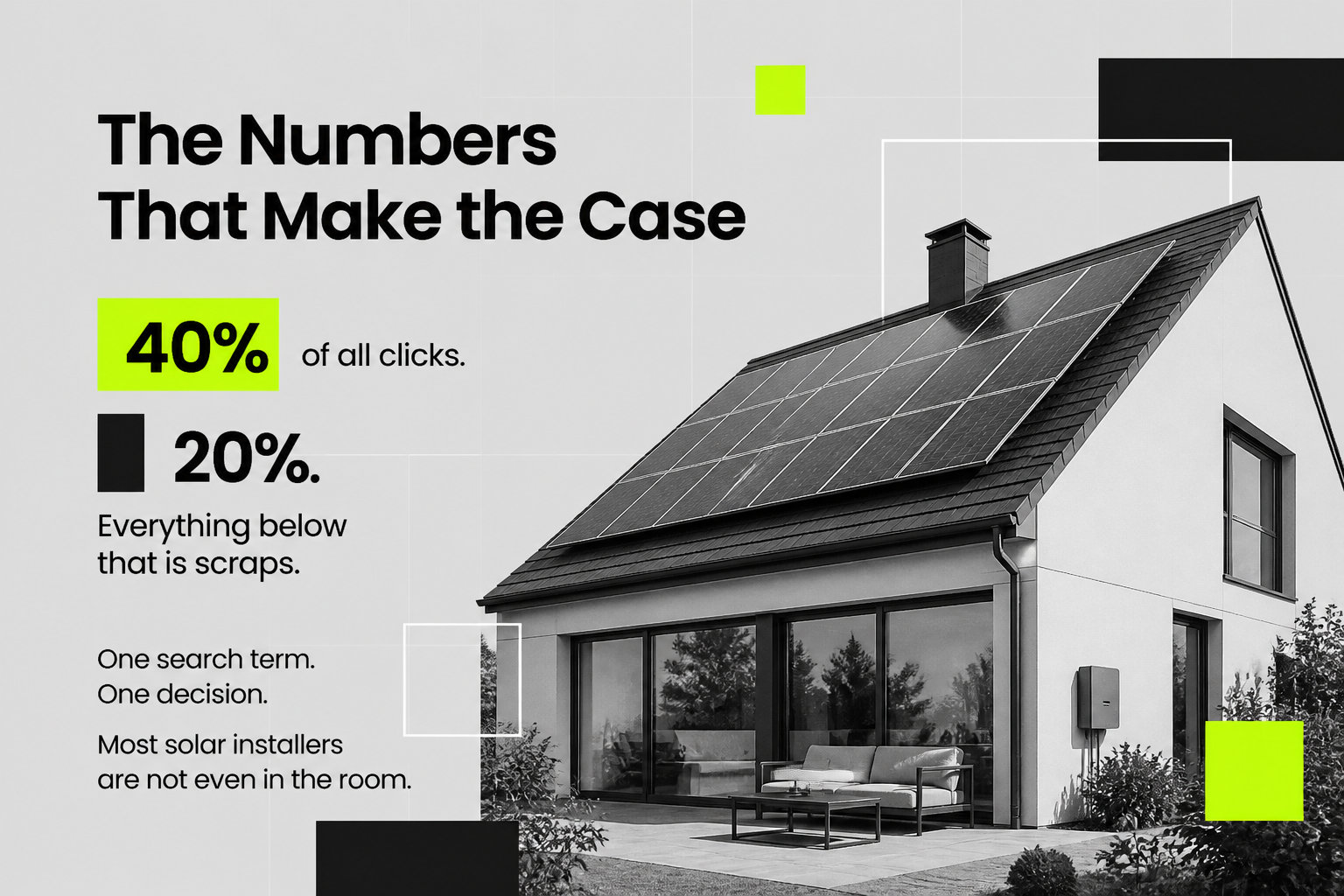
Position one on Google captures 40% of all clicks for a given search. Position two gets around 20%. By position five, you are getting a fraction. Page two is effectively zero.
Apply that to something like "solar panel installer Somerset." Say that term gets searched 300 times a month. Position one is getting 120 of those visits. If your site converts at 5%, that is six inbound enquiries a month from a single keyword, without spending anything on advertising. Across a cluster of ten related local terms, that compounds into fifteen to thirty warm enquiries a month from organic search alone.
At an average solar job value of fifteen to twenty thousand pounds, the maths does not need much explaining. The question is not whether SEO is worth doing. The question is whether you are going to do it before the installer in your area who is already thinking about it.
Key points:
Position one takes 40% of clicks, position two takes 20%, everything below drops steeply
A single local keyword ranking well can generate six or more inbound enquiries per month
Across a cluster of local terms the numbers compound fast
At solar job values, the return on ranking well is significant and the cost of not ranking is equally significant
What SEO Actually Is
SEO stands for search engine optimisation. It is the process of making your business show up as high as possible on Google when someone searches for what you offer.
That is the simple version. The fuller version is that SEO is not one thing. It is a collection of signals that Google uses to decide which businesses deserve to be seen and which ones get buried. Those signals come from your website, but they also come from everywhere else your business exists online.
Most solar installers think SEO means writing some blog posts. That is one small part of it. The businesses that rank consistently and hold those positions are doing something broader: they have built a genuine, coherent presence across the internet. Google reads all of it.
Key points:
SEO is how you earn organic visibility on Google without paying per click
It draws on signals from your website and from everywhere else your business exists online
Blog content is one input among many, not the whole picture
The businesses that rank well have built a presence, not just a website
Why SEO Is Not Just About Blogs
The blog-heavy view of SEO is understandable. Content is a real signal and a useful one. But if you only publish blog posts and ignore everything else, you are building on one leg.
Google does not just look at your website when deciding where to rank you. It looks at the coherence of your business across the entire web. Are your business details consistent everywhere they appear? Do other websites reference you? Do real customers talk about you publicly? Is there evidence that your business is active, trusted, and genuinely local?
A solar installer with a well-written blog but a half-finished Google Business Profile, no directory listings, no social presence, and no external mentions is sending Google a mixed signal at best. The blog says "I exist." Everything else says "I am not sure." That ambiguity costs you rankings.
The approach that actually works treats SEO as a full-internet problem, not a website problem.
Key points:
Blog content is one SEO signal among many, not the whole strategy
Google assesses your business across the entire web, not just your site
Inconsistent or absent presence outside your website undermines the work you do on it
Treating SEO as a full-internet problem is what separates businesses that rank from ones that plateau
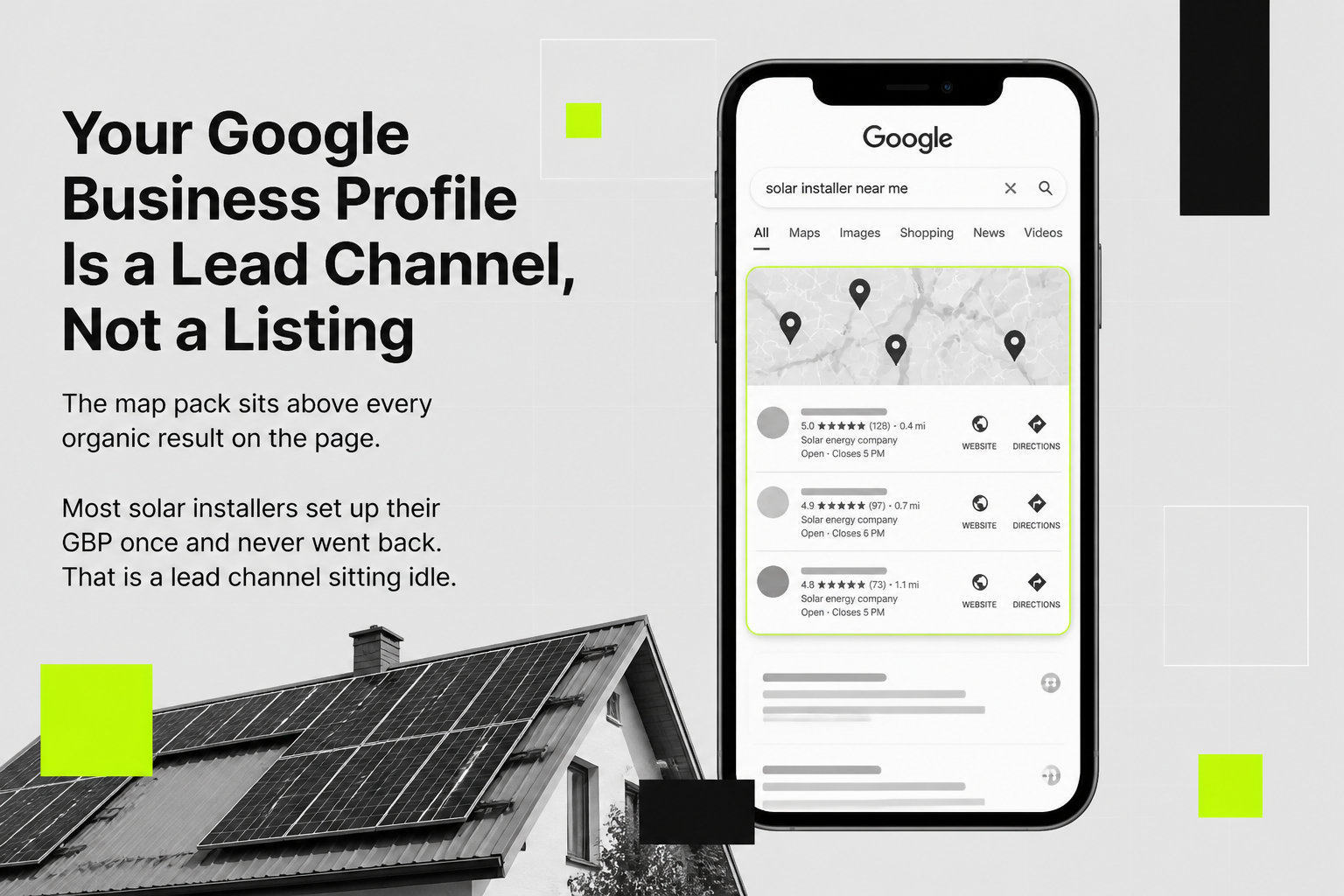
Your Google Business Profile Is a Lead Channel, Not a Listing
Most solar installers have a Google Business Profile. Most of them set it up once and never touched it again.
That is a significant missed opportunity. Your GBP is not just a directory entry. It is often the first thing a homeowner sees when they search for an installer in their area. The map pack, those three businesses that appear above the organic results with reviews and a location pin, gets a substantial share of clicks before anyone even reaches the standard search results. Being in that pack for local searches is one of the highest-leverage positions available to a local service business.
Getting there and staying there requires treating your GBP as an active channel. That means keeping your service list complete and specific, posting updates regularly, responding to every review, adding photos of real installs, and making sure your business details match exactly what appears on your website and every other directory. Google uses GBP data to cross-reference everything else it knows about you. Inconsistencies are a penalty. Consistent activity is a signal that your business is real, current, and worth showing.
Key points:
The Google map pack appears above standard search results and captures a significant share of clicks independently
An inactive GBP is a missed ranking opportunity that most competitors are also ignoring
Regular posts, photo updates, review responses, and consistent business details all contribute to map pack rankings
Your GBP details must match your website and every directory exactly or you introduce ambiguity that costs you position
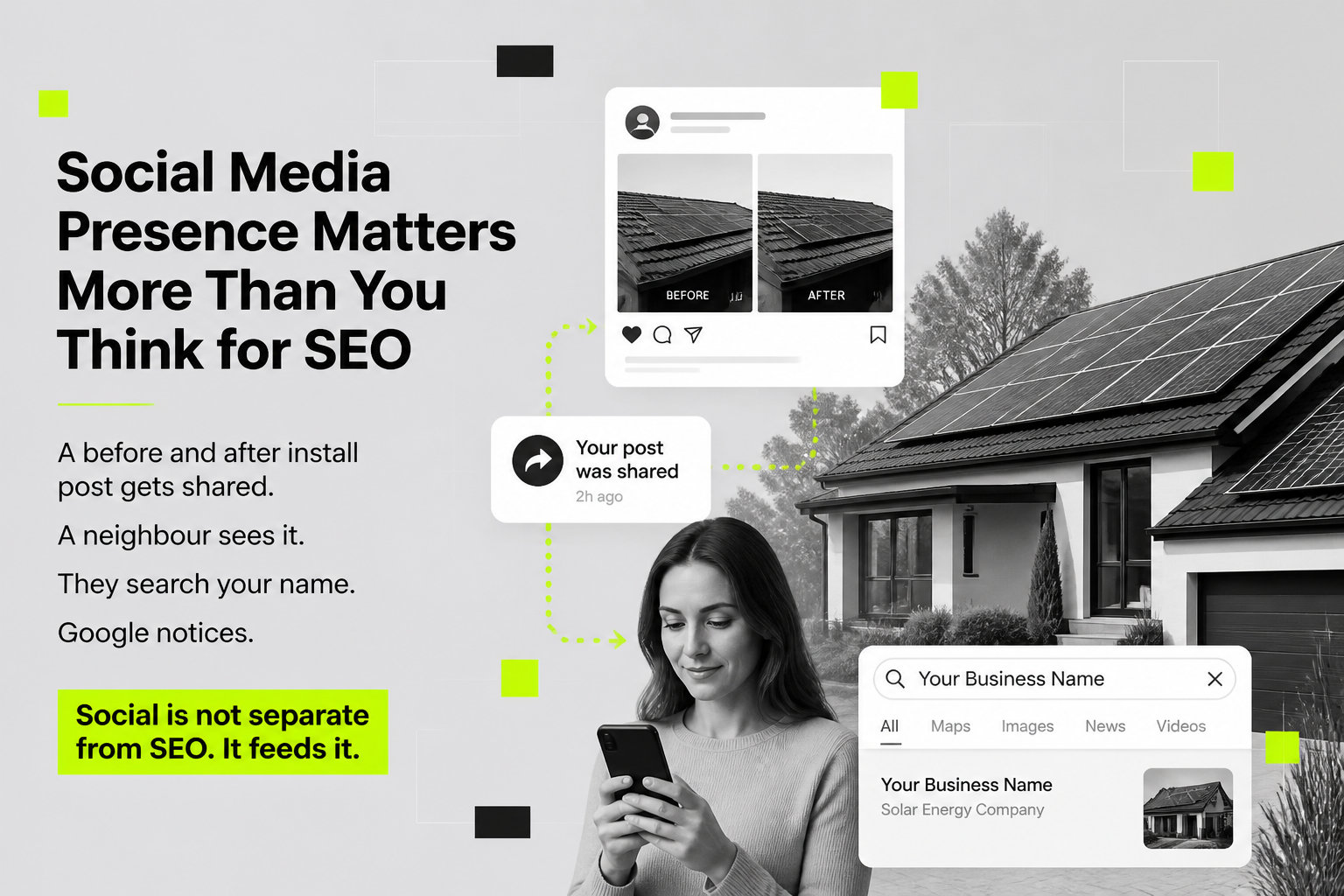
Social Media Presence Matters More Than You Think for SEO
Social media does not directly determine your Google rankings in the way that backlinks or on-page content do. But it contributes to the broader picture of whether your business looks real and active to the internet.
When Google encounters a business name, it cross-references what it can find. A solar installer with an active Facebook page showing recent installs, a LinkedIn presence, and genuine engagement looks different to one that has no social footprint at all. It is a trust signal. It tells Google that a real business is operating here, that people are interacting with it, and that it is current.
For solar specifically, social content also drives direct referrals. A before-and-after post of a Taunton install gets shared by the homeowner, seen by their neighbours, and creates both brand awareness and inbound links back to your site. That is off-page SEO happening organically because you were active.
You do not need to post every day. You need to post consistently, show real work, and give people something worth sharing.
Key points:
Social presence contributes to the broader trust signals Google uses to assess your business
An active, consistent social presence looks different to no social footprint at all
Real install content generates organic sharing, which creates backlinks and brand awareness simultaneously
Consistency matters more than volume: showing up regularly with real work beats sporadic bursts
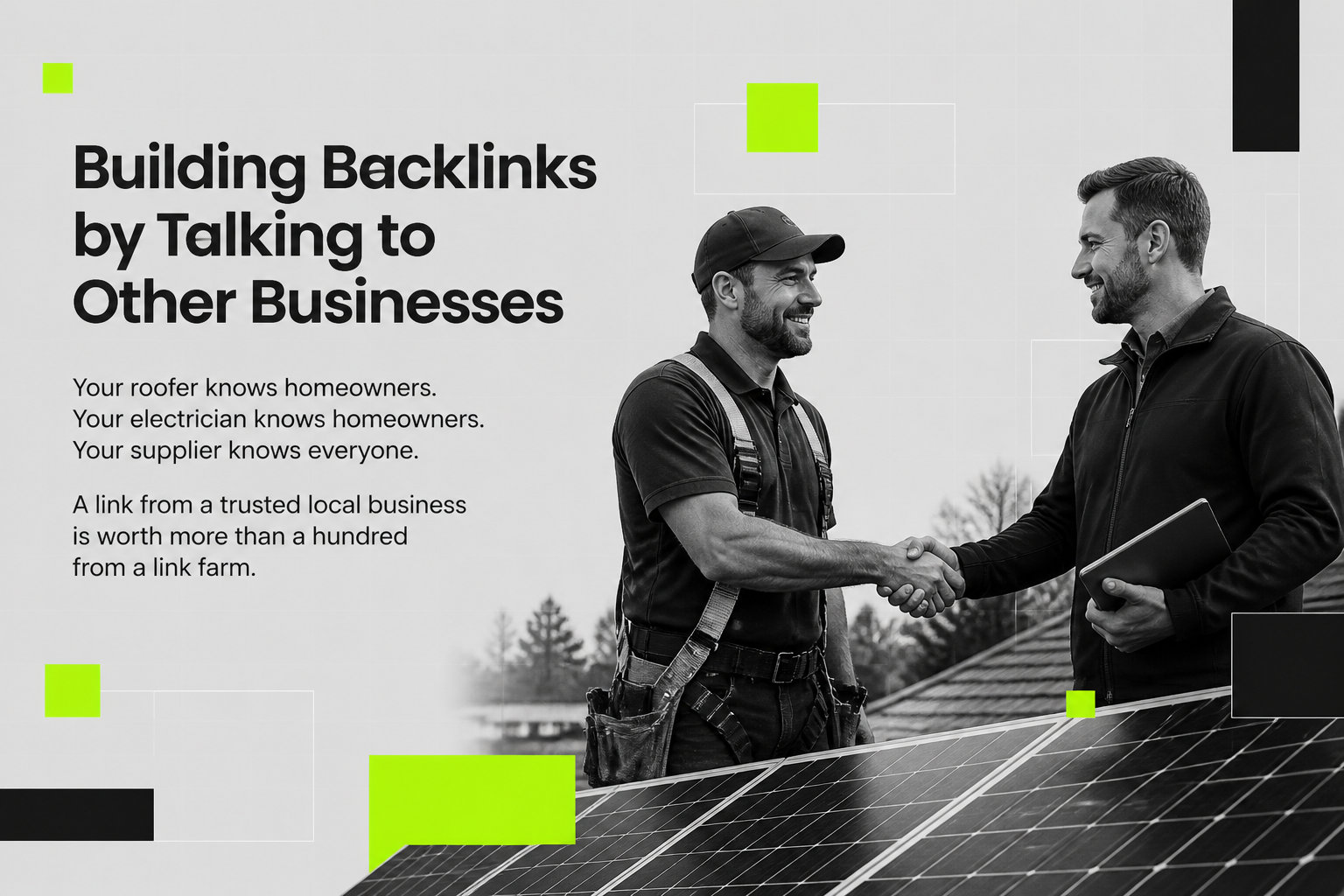
Building Backlinks by Talking to Other Businesses
A backlink is a link from another website to yours. When a trusted external site links to your business, it passes authority. Google reads it as a vote of confidence. The more legitimate votes you have from credible sources, the more trustworthy your site appears, and the easier it becomes to rank.
Most solar installers do not think about this at all. The businesses that do have a material advantage.
The most accessible way to build backlinks as a local installer is through relationships you probably already have or could easily develop. Suppliers, roof replacement companies, electricians, architects, local builders, planning consultants. These are businesses that serve the same homeowners you do at adjacent points in the same journey. A mutual mention and link between your site and theirs is straightforward to arrange and genuinely valuable to both parties.
Local press is another route. A well-placed story about a community solar project or an unusual install can earn a mention and a link from a local news site. That kind of coverage carries real authority because the domain has been around for years and Google trusts it.
The key is that backlinks need to be legitimate. Links from real businesses, real publications, and real directories that are relevant to your geography or industry. A handful of these from credible sources is worth more than hundreds from low-quality link farms, which can actively damage your rankings.
Key points:
Backlinks from credible external sites signal trust to Google and directly help you rank
Relationships with adjacent local businesses, suppliers, and trade partners are the most accessible source
Local press coverage earns high-authority links that carry lasting weight
Quality and relevance matter far more than volume: a few credible links outperform hundreds of questionable ones
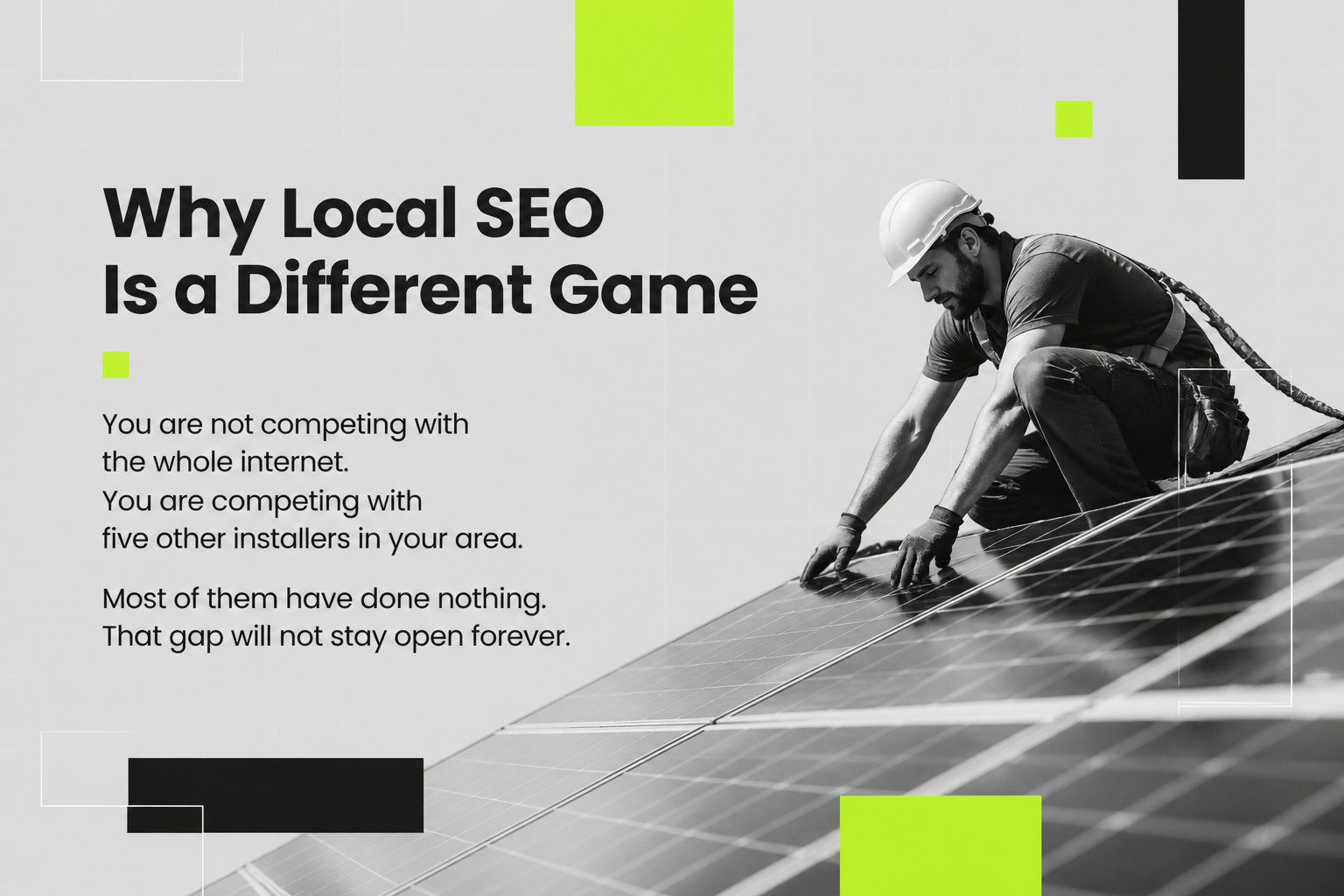
Why Local SEO Is a Different Game
National SEO means competing with the biggest energy companies, national comparison sites, and brands with dedicated teams spending serious money on content and links. That fight is not worth picking for a regional installer.
Local SEO is a completely different proposition. When someone searches for a solar installer in your specific area, the competition narrows to the five or ten businesses operating in the same geography. Most of them have weak websites, inconsistent listings, no social presence, and no external links. The baseline is low.
That gap is the opportunity. A business that shows up with a properly optimised website, an active GBP, consistent directory listings, real social content, and a handful of legitimate backlinks can move into position one for local searches significantly faster than most people expect. You do not need to outspend anyone. You need to do the basics properly in a space where most competitors have not bothered.
Key points:
Local SEO is a fundamentally more winnable competition than national search
Your real competition is five to ten local installers, most of whom have a weak online presence
A coherent full-internet presence stands out sharply against that baseline
You do not need a large budget, you need consistent effort across the right channels
The Honest Reality About How Long This Takes
SEO is not instant. Anyone who says otherwise is selling you something.
The uncomfortable truth is that if you start the wrong strategy today, you might not find out it was wrong for two or three years. By then you have wasted time and money, and more importantly, a competitor has been building something that works in the same window.
Done properly, a local solar installer can start to see meaningful movement in three to six months. Holding position one for competitive terms typically takes longer. But the compounding nature of it means that once you are there, you are significantly harder to dislodge than you were to get there in the first place.
The businesses that win are not the ones trying to rush it. They are the ones that started before their competitors and treated it as a system to maintain, not a project to complete.
Key points:
Meaningful movement typically appears in three to six months with the right approach
The wrong strategy can run for years before the cost becomes obvious
SEO compounds: positions held are harder to lose than they were to win
Starting earlier than your local competitors is the single biggest structural advantage available
Where to Start
The same starting point applies regardless of where you currently sit in the rankings.
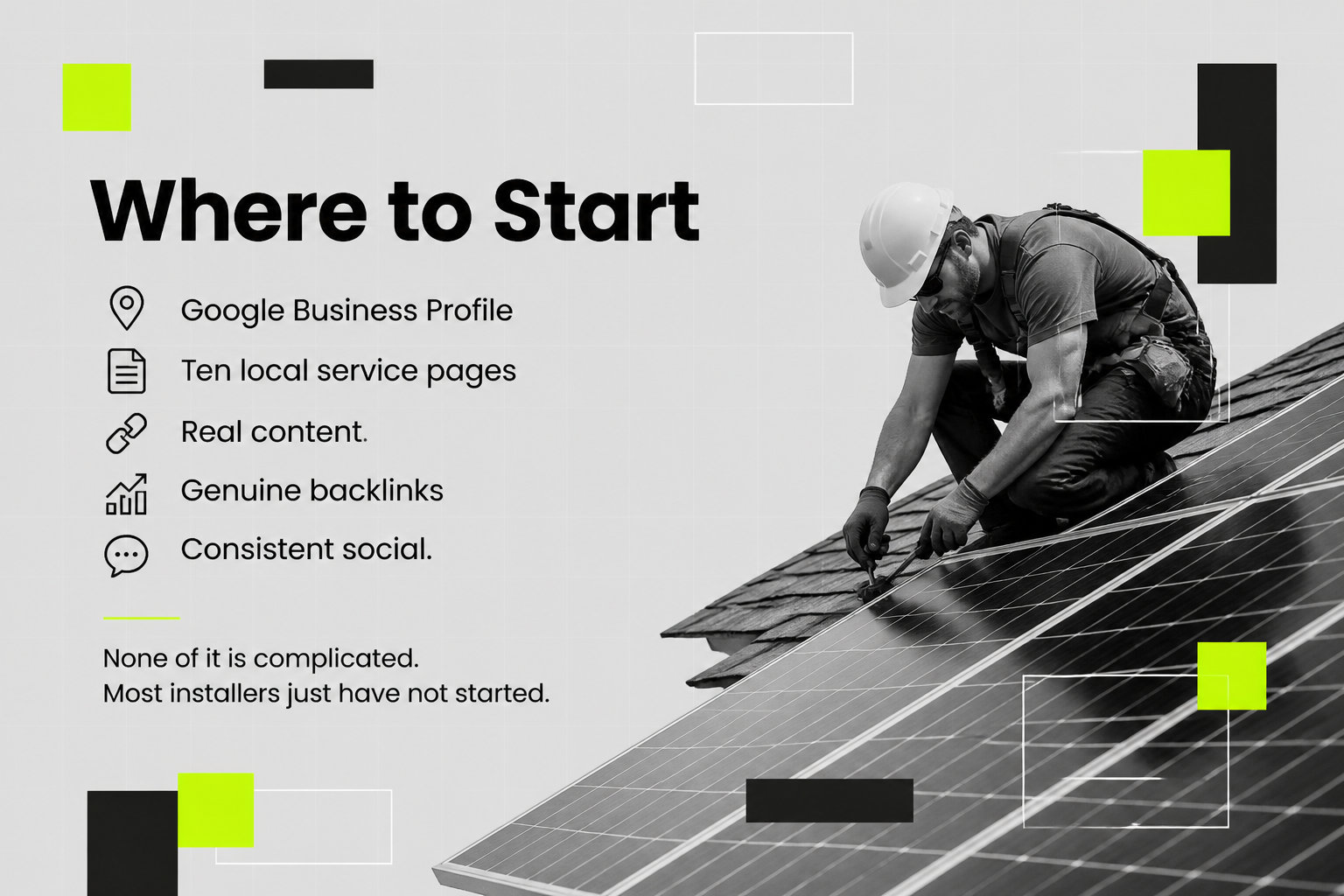
Get your Google Business Profile fully complete and start treating it as an active channel. Make sure your business details are identical across every directory, every listing, and your own website. Start building real relationships with adjacent local businesses and look for natural opportunities to earn links. Post consistently on social with real work from real installs. Identify the ten to fifteen local keywords that represent genuine buying intent and build a substantive page for each one. Then produce useful content that answers the questions homeowners ask while they are still deciding.
None of this is complicated. Most of it is just consistent effort in the right places, applied over time.
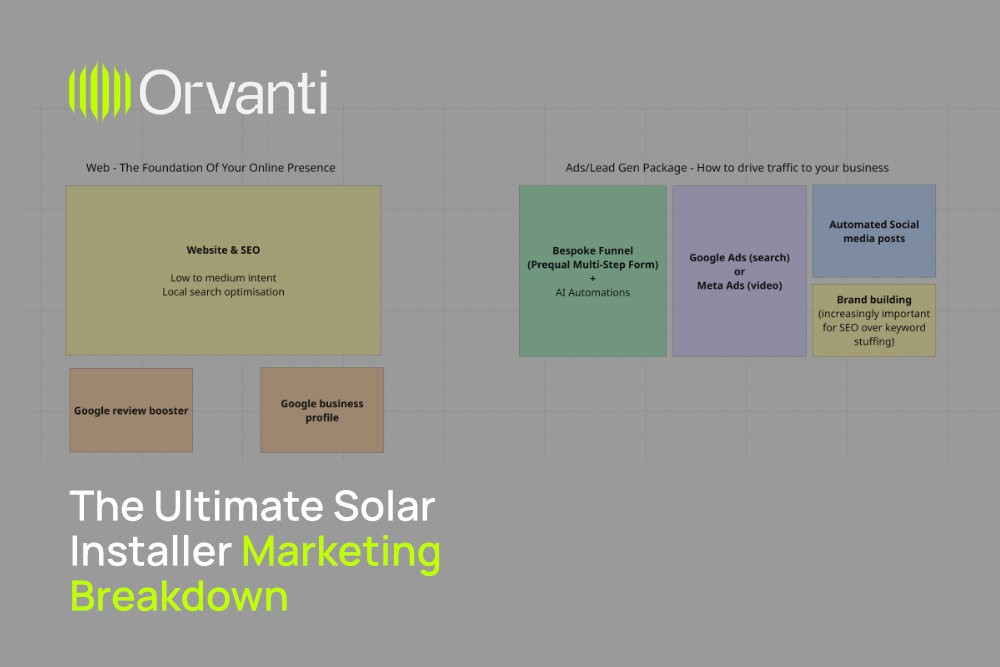
If you want to see what this looks like as a connected system built specifically for solar installers, take a look at how we approach it at Orvanti. It covers the full acquisition model, including SEO, Google Ads, and the AI-powered follow-up layer that converts more of your traffic into booked appointments.
Key points:
GBP, consistent directory listings, and a coherent brand presence are the foundation before anything else
Local backlinks through business relationships and press are more accessible than most installers realise
Ten to fifteen location-specific service pages built around real keyword data are the core of local search visibility
The full connected system is at orvanti.ai/solar-lead-system


Why Choose Orvanti?
Expertise You Can Trust
Our team brings years of industry experience to deliver high-quality ads, conversion and prequalification systems
Tailored Approach
We craft customised strategies that align with your unique business needs and financial objectives.
Data-Driven Insights
Our cutting-edge analytics and financial modeling ensure informed decision-making for long-term success.
Proven Results
We have a track record of helping businesses enhance financial efficiency, manage risks, and achieve their goals.